
There is no single right answer in 2026, because there is no single market. First-timers should take the BTO supply while it is this wide. Upgraders face a flat flat-price and a rising condo price, so waiting costs them money. Buyers hoping for a fall are betting against land already bought at record prices.
Every week the same conversation happens in three versions. A young couple asks whether to ballot for a BTO flat or pay more for a resale one. A family in a paid-up four-room flat asks whether upgrading still makes sense. And someone with cash asks the oldest question of all: buy now, or wait?
These are three different questions with three different answers. They are driven by three parts of the market moving at three different speeds. Rolling them into one question, "is property expensive right now?", is how people freeze for years. Or worse, how they make a decision built for someone else's life. Here is what the data says for each group.
Five terms used in this article
- BTOBuild-To-Order. A new HDB flat you apply for before it is built, sold at a subsidised price
- Resale Price IndexHDB's quarterly measure of how much resale flat prices have moved overall
- psfPer square foot. The price of a home divided by its floor area, used to compare homes of different sizes
- GLSGovernment Land Sales. The programme through which the state sells land to developers by tender
- TDSRTotal Debt Servicing Ratio. A rule capping all your monthly loan repayments at 55% of your income
Should first-time buyers ballot for a BTO flat in 2026?
Yes, if you can wait three to four years. Start with supply, because it settles most of the argument. HDB is launching 19,600 BTO flats in 2026, the same high pace as 2025. It is on track to beat its original target of 55,000 flats for 2025 to 2027. About 4,000 of this year's flats will be ready in under three years. That removes the oldest objection to BTO, which was the wait.
The timing helps too. February offered 4,692 flats. June offered 6,860. October is expected to offer around 8,000. Supply is a rising staircase. So a failed ballot in June is not a disaster. A bigger exercise is only months away.
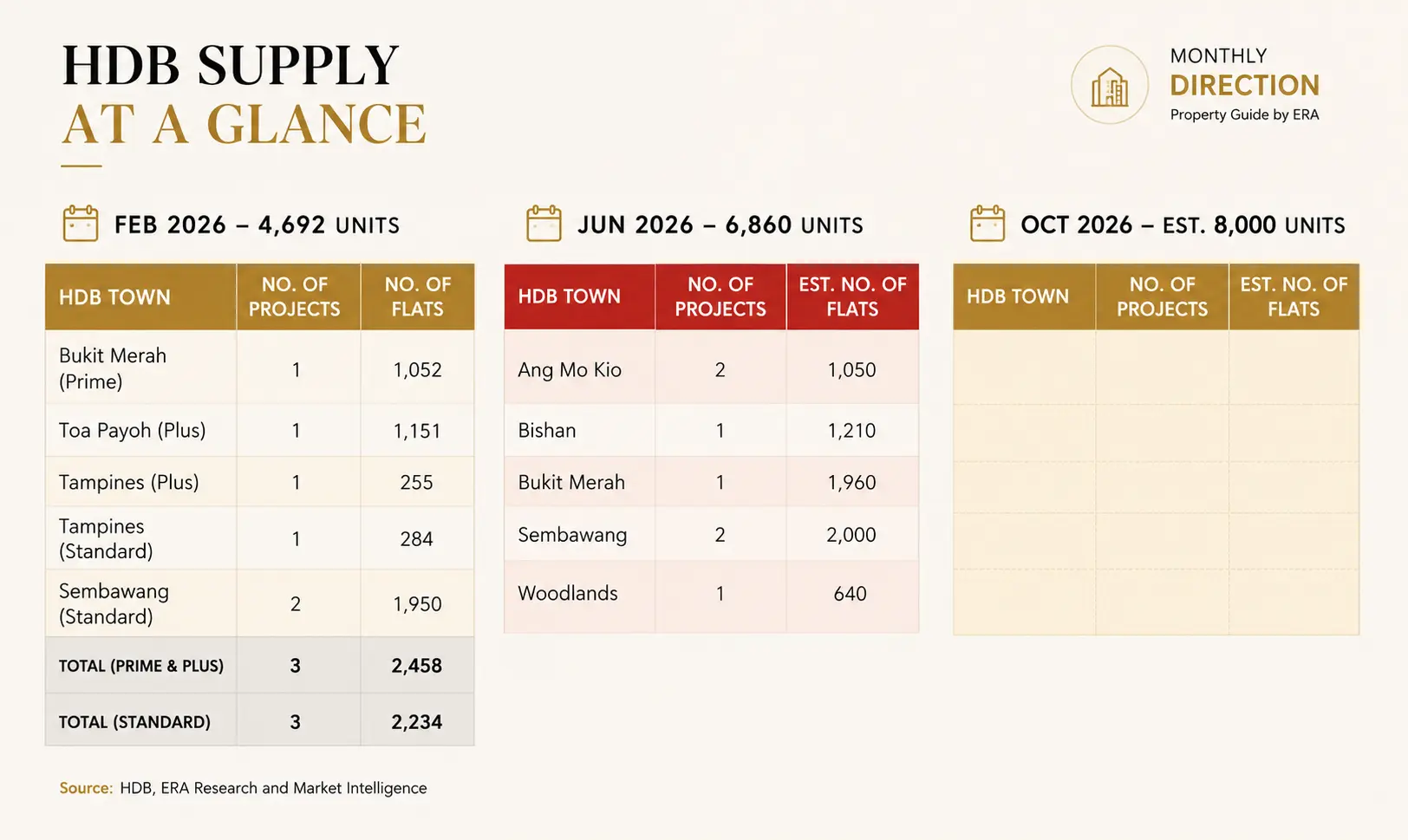
June was unusual for its locations. Bishan offered 1,210 flats near Marymount MRT, a short walk from Shunfu Mart and MacRitchie Reservoir. Bukit Merah offered 1,960 flats right beside Telok Blangah MRT, next to the market and The Southern Ridges. Central sites like these used to come once in a blue moon. Two in one exercise says HDB wants to give first-timers real choices, not just flats on the edge of town.
The money side is just as clear. The income ceiling is $14,000 for couples and $7,000 for singles, or $21,000 for extended families. The booking fee for a 4-room flat is $2,000. With an HDB loan, the staged payments can be covered almost entirely by CPF. Subsidised price, priority in the ballot, and payments spread over the build. Nothing on the private market comes close for a couple starting out.
My honest take: if you qualify and can live with the wait, ballot. The only first-timers I point to resale are those with a fixed location need, such as parents, a school or a workplace, or those who need a home now. Resale is still within reach for them, as the next section shows. But you are paying extra for convenience, and it helps to call it that.
Have HDB resale prices peaked, and what does that mean for upgraders?
They have levelled off rather than fallen, and that changes the sums. Resale prices grew hard from 2021 to 2024: double digits in 2021, high single digits in 2022 and again in 2024. In 2026 the Resale Price Index slipped −0.1% in the first quarter, which is flat. ERA's research desk expects 2% to 5% for the full year.
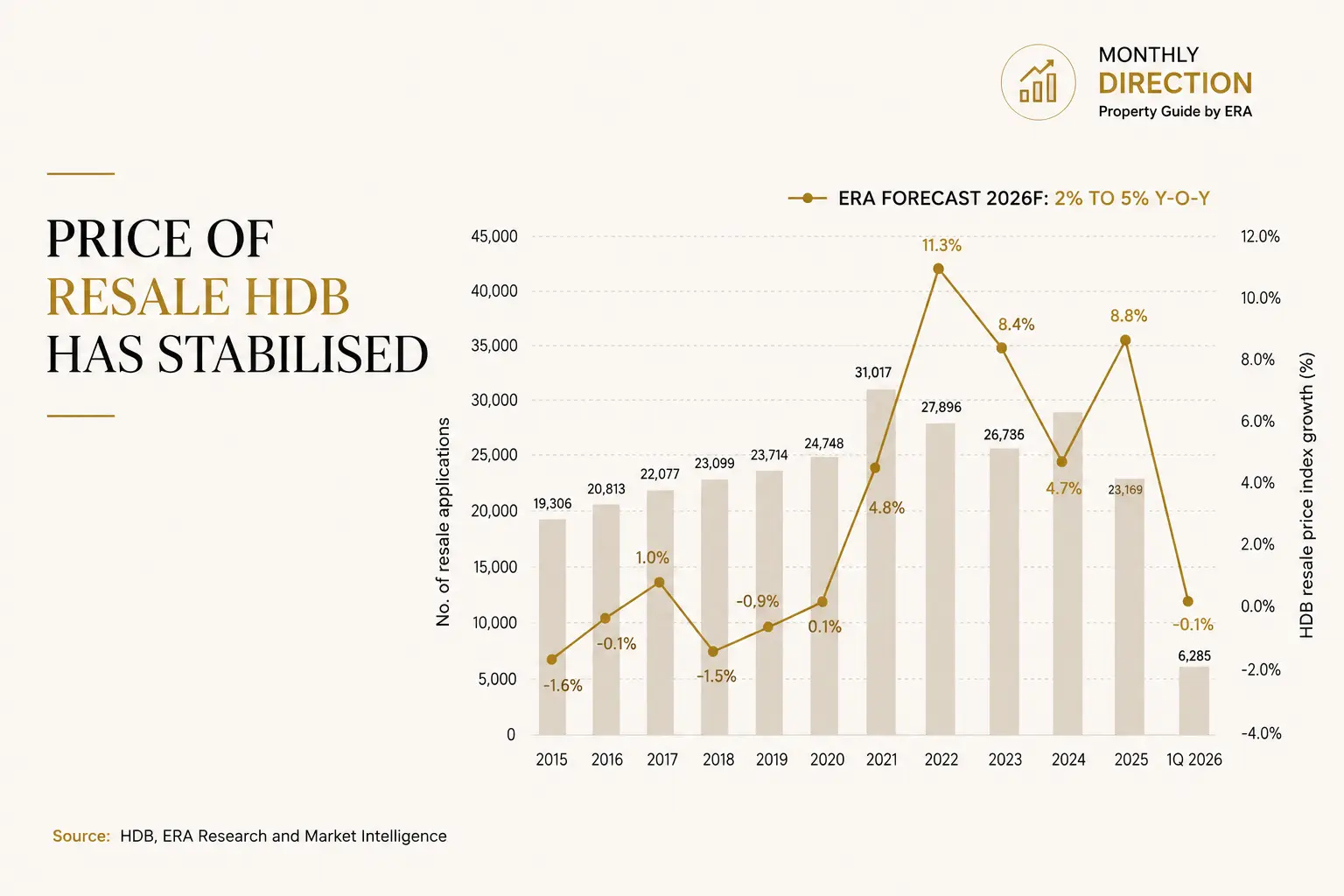
Headlines say otherwise, because records keep falling at the very top. A five-room flat on Henderson Road in Bukit Merah sold for $1.728 million, or $1,421 psf, in April. That was a national record. A Clementi five-roomer went for $1.58 million, or $1,299 psf, in May, a town high. Both had long leases left and an MRT station at the door. They are real sales. They are also the top 1%, not the market.
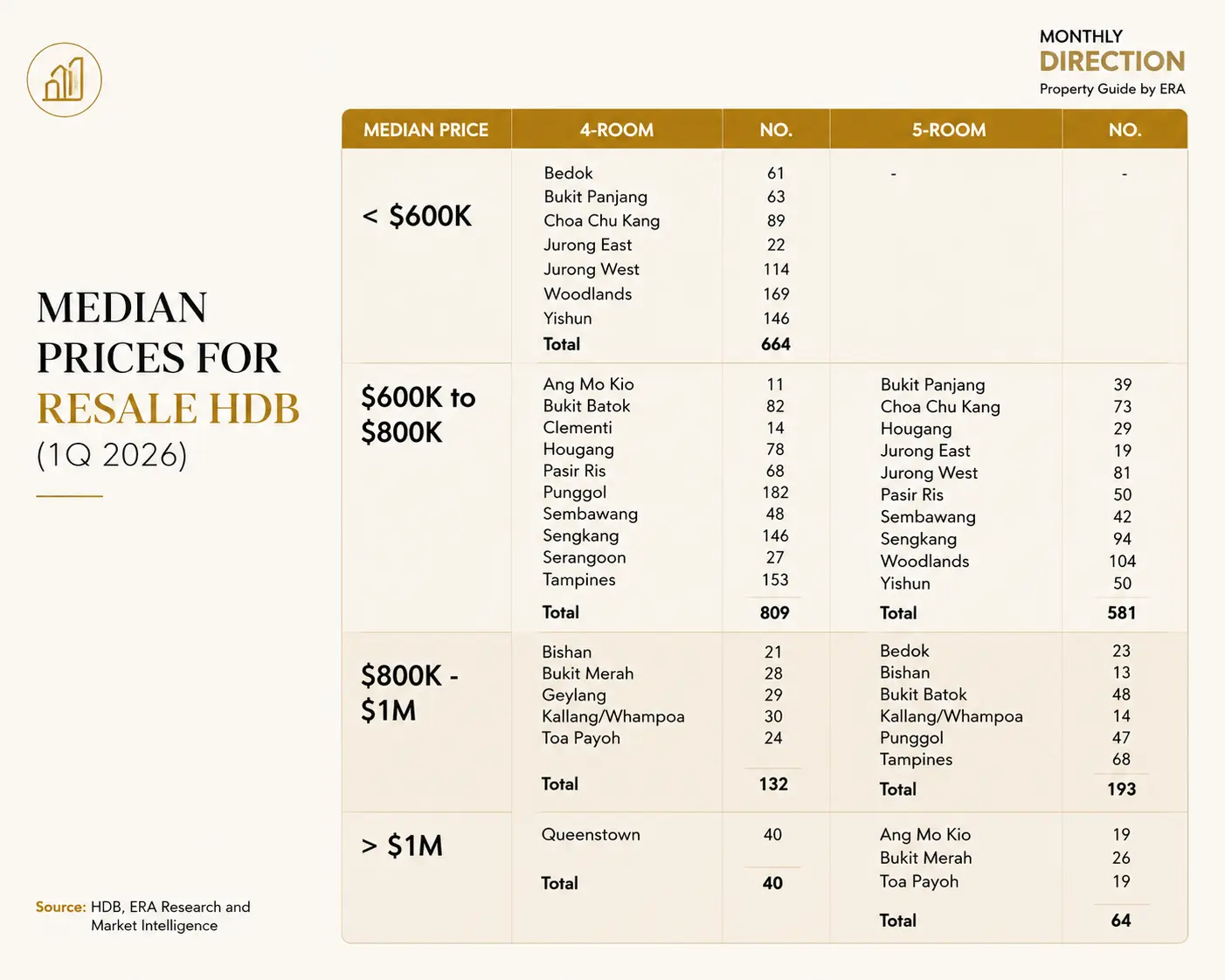
The market is the middle. Most HDB towns still sell 4-room flats below $800,000. In Woodlands, Yishun, Jurong West and Choa Chu Kang the middle price stays under $600,000. Only Queenstown's 4-room median crosses a million dollars.
Why does levelling off matter so much if you want to upgrade? Because an upgrade has two prices, not one. When flats were rising 9% to 11% a year, waiting was free. Your flat gained value at roughly the same speed as the condo you wanted. Now your flat is flat and condo prices are still rising. So every year you wait, the gap between what you can sell for and what you must pay gets wider. That gap is the money you have to find, out of CPF, savings or a bigger loan. Asset progression is really just the management of that gap.
This is not an instruction to upgrade. If your income cannot clear the Total Debt Servicing Ratio with room to spare, or your family plans are unsettled, staying in a paid-up flat is a strong position. But if you were going to upgrade within five years anyway, the case for going earlier is stronger this year than at any point since 2021.
Is it worth waiting for new launch prices to fall?
The land market says no. Land is the biggest cost inside any launch price, and the state sells it by tender a year or two before the showflat opens. The second-half 2026 programme, announced on 3 June, carries roughly 9,200 units. That is a Confirmed List of about 4,745 units, which the state sells regardless of demand, and a Reserve List of about 4,455 units, released only if a developer commits to bid. Supply is generous. Prices are not.
| Site | Region | Est. units | Tender launch |
|---|---|---|---|
| Town Hall Link (white site) | OCR | 1,200 | Jul 2026 |
| Marina Gardens Lane | RCR | 390 | Aug 2026 |
| Orchard Boulevard | CCR | 110 | Aug 2026 |
| East Coast Road | OCR | 85 | Sep 2026 |
| De Souza Avenue | RCR | 415 | Nov 2026 |
| Tanjong Rhu Road | RCR | 505 | Nov 2026 |
| Berlayer Close | RCR | 695 | Dec 2026 |
| Holland Plain | CCR | 610 | Dec 2026 |
| Jurong East Avenue 1 (EC) | OCR | 735 | Dec 2026 |
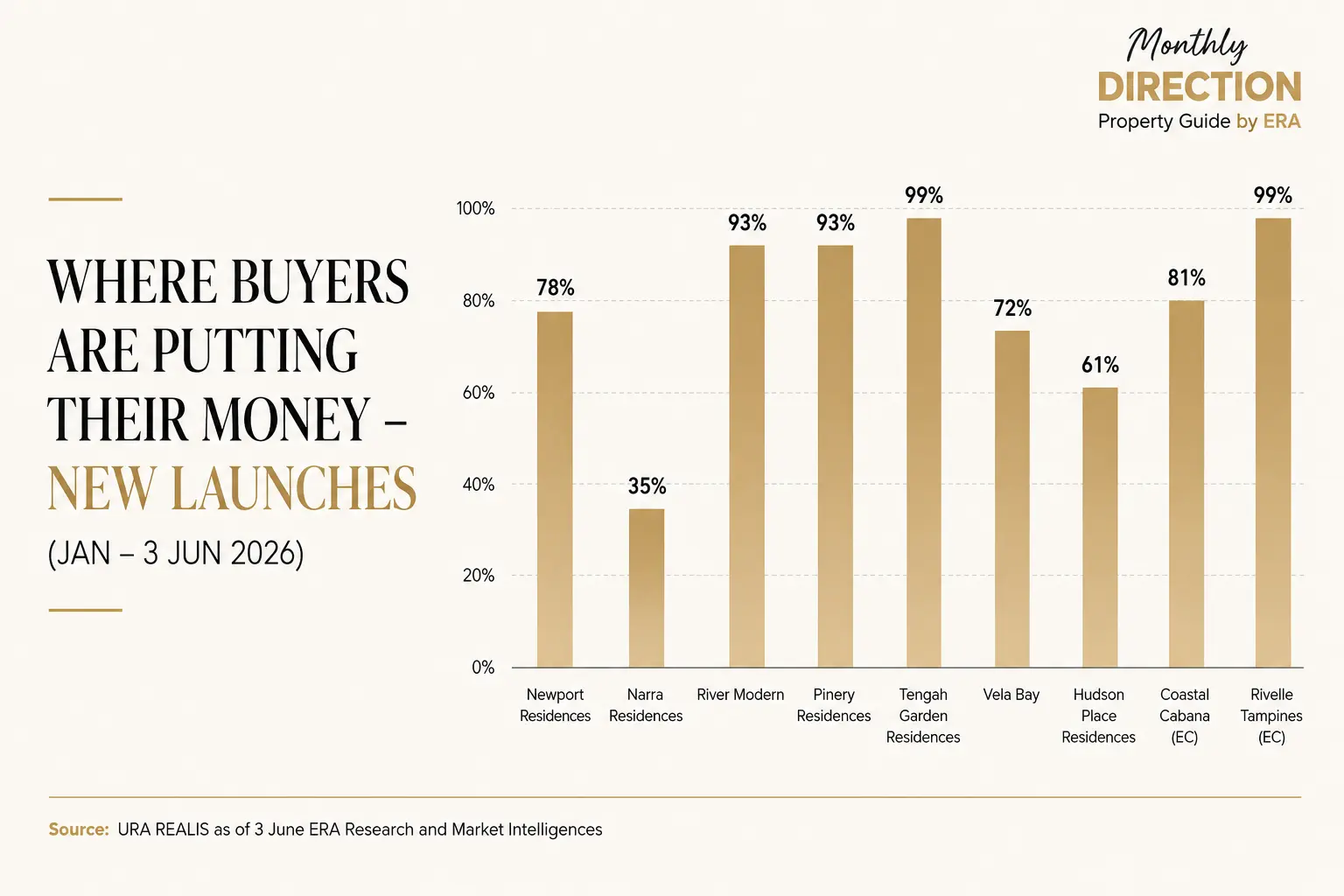
Watch what developers pay for these plots and you can read 2027 and 2028 launch prices before a showflat opens. That is the whole point of this site's GLS pipeline tracker. Land rates have climbed in every region, and developers pass land costs into launch prices. So "waiting for cheaper new launches" is really a bet that developers will sell below what the project cost them. That happens occasionally, in bad markets. With buyers absorbing launches at the rates below, 2026 is not one of those markets.
The longer trend is in the middle prices. New-home medians have climbed from $2,496 psf in the CCR (Core Central Region), $1,813 in the RCR (Rest of Central Region) and $1,548 in the OCR (Outside Central Region) in 2020, to $3,184, $2,635 and $2,276 in the first half of 2026. In the first quarter of 2026 the overall new-sale median passed $2,662 psf. DBS expects growth of 2% to 3% a year, which would take the median to about $3,000 psf by 2030 and $4,000 by 2040. That echoes a Morgan Stanley call from 2017 that Singapore home prices would double by 2030.
Hold those long forecasts loosely. Drawing a straight line through ten years of possible policy changes is a brave assumption, and no bank's chart survives a new cooling measure. But the direction over any five-year window has been consistent. And the reason is visible in public tender results today, not in a forecast: land costs rise, then launch prices follow. I set out the wider case, covering interest rates, incomes, land, policy and the economy as one framework, in From noise to clarity: five forces shaping Singapore property in 2026.
Three launches are worth watching in the second half. Lentor Gardens Residences brings 499 units near Lentor MRT in July, and our Lentor page shows the area's first profitable resales. Dunearn House brings 380 units in District 11 near Sixth Avenue MRT, also in July. And the quarter's giant is Thomson Reserve, 1,268 units on the site of the former Thomson View, next to Upper Thomson MRT. Each is priced off land bought at today's rates. That is exactly why projects already on the market, priced off cheaper older land, are the quiet value story of 2026. If you are weighing that choice, the new launch versus resale comparison covers the mechanics.
How should you decide: by life stage or by market timing?
By life stage. Pull the three threads together and the market is not sending one signal. It is sending three.
- To first-timers: supply is plentiful, subsidised and better located than before. The system is built for you right now. Use it.
- To upgraders: the home you would sell has stopped rising. The home you would buy has not. Waiting is no longer free.
- To investors: land costs have already set a floor under 2027 and 2028 launch prices. The value in 2026 sits in what is already launched, not in what is coming.
None of this replaces your own sums. You still need loan headroom, savings to hold through a bad year, a family timeline and an idea of when you would sell. A correct read of the market with the wrong personal maths is still a bad purchase. But in my experience the opposite error is more common: people with sound finances waiting for a signal that land tenders, launch take-up and supply figures say is not coming.
The best housing decision in 2026 depends on your stage of life. That sounds obvious until you notice how many people do it backwards. They let the market's mood decide, when the market is not even talking to them.
Half a year on, the supply picture has shifted. A record wave of flats reaching the end of their minimum stay is hitting the resale market, while the new-launch pipeline thins out. I updated the reading in A record MOP wave meets a thin launch pipeline.
The short version — read this first
Six things to take away before you decide anything.
What the data says
- First-timers19,600 BTO flats launch in 2026, about 4,000 of them ready in under three years. The system is built for you right now
- Two rare central launchesJune offered 1,210 flats in Bishan and 1,960 in Bukit Merah, both beside an MRT station
- HDB resale has levelled offThe index moved −0.1% in the first quarter of 2026. ERA expects 2% to 5% for the full year
- Million-dollar flats are not the marketMost towns still sell 4-room flats below $800,000. Woodlands, Yishun, Jurong West and Choa Chu Kang stay below $600,000
- Waiting has a price for upgradersYour flat has stopped rising. Condo prices have not. Each year of waiting widens the gap you must fund
- Land has already set 2027 pricesDevelopers bought land at record rates and must recover it. Waiting for cheaper launches is a bet against their own cost
So what should you do with this?
- Work out which of the three groups you are in first. Answering the wrong question is the expensive mistake here.
- If you are upgrading, get your flat valued and get a bank to confirm what you can borrow. Those two numbers settle the question faster than any forecast.
- If you are waiting for a fall, write down what would have to happen to cause one. If you cannot name it, you are not waiting for a reason.
Frequently asked questions
Should first-time buyers choose BTO or resale HDB in 2026?
For most first-timers who can wait, BTO is the cheaper entry. There are 19,600 flats launching in 2026, around 4,000 of them ready in under three years, and June included rare central sites in Bishan and Bukit Merah. Choose resale when location, moving in now, or flat size genuinely matters more than the price gap. Most towns still have median resale prices below $1 million.
Is it worth waiting for private property prices to fall?
The land market argues against it. State land prices kept rising through 2025 and 2026, and those costs are locked into projects launching in 2027 and 2028. New-sale medians passed $2,600 psf in the first quarter of 2026, and DBS expects 2% to 3% growth a year over the long run. Waiting is a bet that developers will sell below what their land cost them, which is rare outside a slump. Test your own affordability instead of trying to time the cycle.
Have HDB resale prices peaked?
Levelled off is the better description. The Resale Price Index was flat, at −0.1%, in the first quarter of 2026 after years of strong growth. ERA expects 2% to 5% for the full year. Records such as the $1.728 million Henderson Road flat are outliers. Most towns still sell 4-room flats below $800,000.
What is in the 2H 2026 GLS programme?
About 9,200 units, announced on 3 June 2026. The Confirmed List has roughly 4,745 units across nine sites, including Marina Gardens Lane, Orchard Boulevard, Tanjong Rhu Road, Berlayer Close, Holland Plain and an executive condominium site at Jurong East. The Reserve List holds about 4,455 more, released only if a developer commits to bid. Tenders open between July and December 2026.
Sources: HDB BTO launch and income-ceiling data; HDB Resale Price Index and 1Q 2026 median transaction data; URA 2H 2026 GLS programme announcement (3 Jun 2026); URA REALIS new-sale caveats as of 3 Jun 2026; EdgeProp reports of 1 May and 7 May 2026 (record resale transactions); DBS Insights and Morgan Stanley long-term price projections; ERA Research and Market Intelligence, Monthly Property Guide, June 2026. Figures reproduced with attribution. All market data is historical; past performance does not predict future prices.