
Singapore's housing demand changed shape in 2026, not size. Cheap BTO flats drew record crowds at the bottom. New rules from 8 May rebuilt the executive condominium market in the middle. And record land prices at government tenders pushed the top up. Same demand, three different causes.
Think of the market as a three-storey building. Each floor is moving for its own reason. This piece takes them one at a time, because the way they push against each other is the real story.
Six terms used in this article
- BTOBuild-To-Order. A new HDB flat you apply for before it is built, sold at a subsidised price
- ECExecutive condominium. A condo built by a private developer but sold with HDB-style rules and income limits. It becomes a normal private condo after 10 years
- MOPMinimum Occupation Period. The number of years you must live in a subsidised home before you may sell it
- psf pprWhat a developer paid for land, per square foot of floor space it is allowed to build
- GLSGovernment Land Sales. The programme through which the state sells land to developers by tender
- OCR / RCR / CCROutside Central Region (the mass-market estates), Rest of Central Region (the city-fringe ring), and Core Central Region (the prime districts, including Districts 9, 10 and 11)
Why is BTO demand so heavy in 2026?
Because the sums are hard to beat. Take the February 2026 launch. A 3-room flat in Tampines priced near $400,000 needs a household income of about $4,600 a month to service on an HDB loan. Even a Prime 4-room flat in Redhill at roughly $600,000 works out at about $6,800 a month. Singapore's median household income sits comfortably above both. No private product asks so little of a young couple.
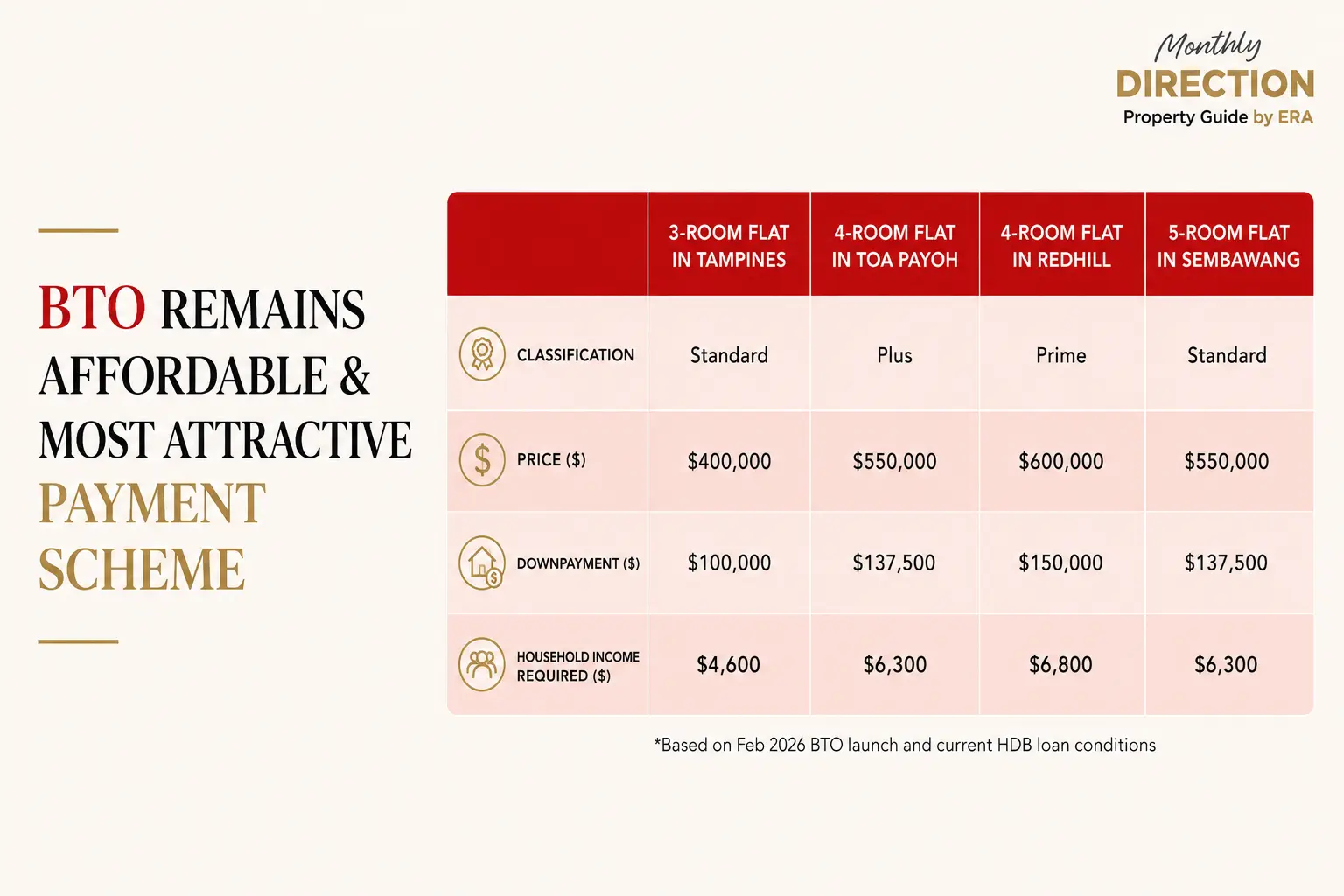
So the queue got long, and it got long unevenly. That exercise drew 9,061 applicants for 3,446 flats. First-timers were mostly fine, because the system reserves flats for them. Second-timers were not. In Bukit Merah, 16.6 second-timers chased each Prime 4-room flat. In Tampines the figure was 39.2. If you are a second-timer counting on BTO, you are buying lottery tickets, not making a plan.
The resale flat market next door is busy but calm. April 2026 saw 1,941 resale deals. Just over half, 51%, were between $500,000 and $750,000. The flats had about 80 years of lease left on average. Yes, 138 flats sold above a million dollars that month. But 138 out of 1,941 is 7%. The headlines come from the tail, not the market.
What changed in the EC rules from 8 May 2026?
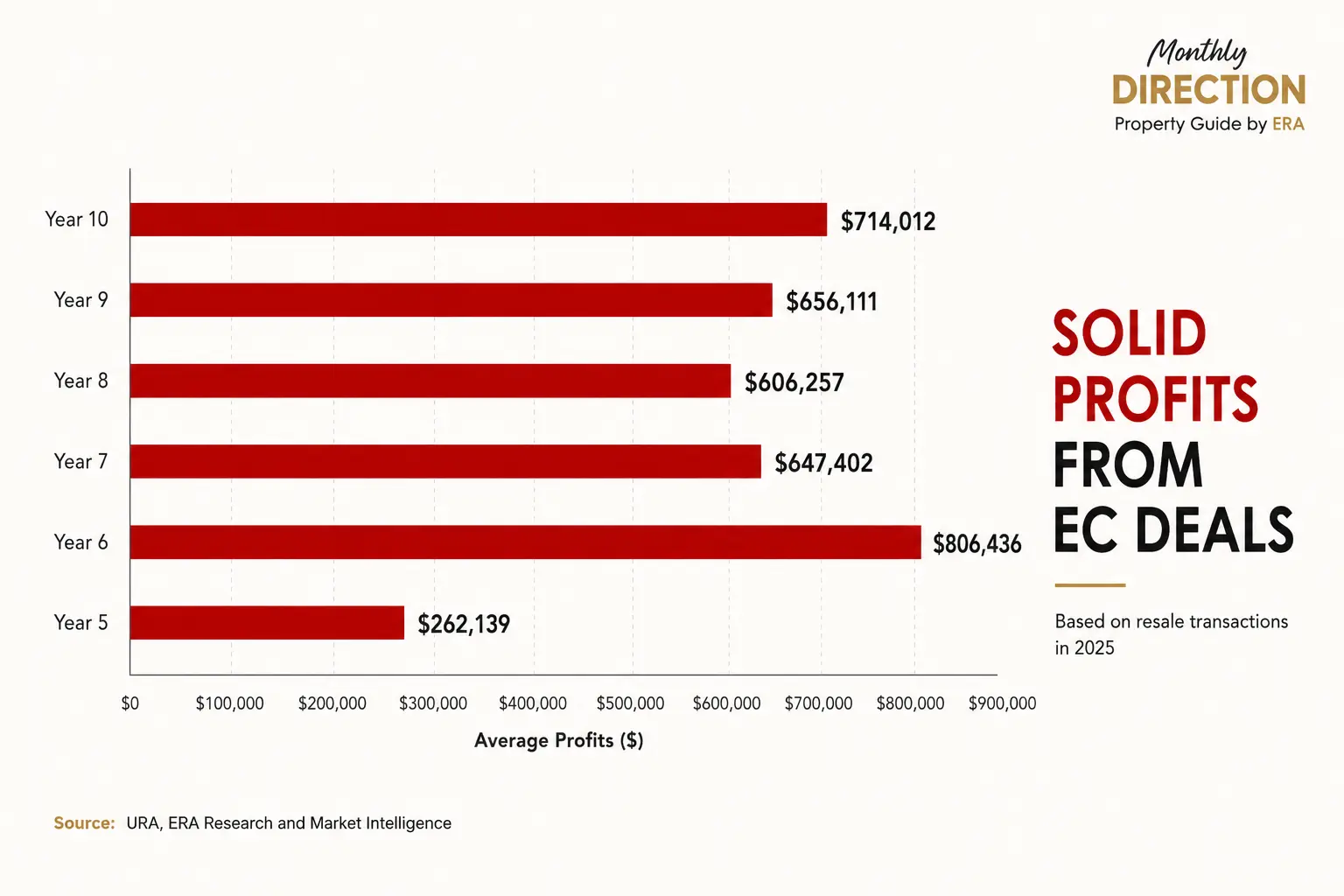
To see why the government stepped in, look at what ECs had turned into. There were 1,943 EC resale deals in 2025. In 65% of them, the seller took a profit within ten years of the project being completed. Owners who sold between years six and ten made average gains of roughly $606,000 to $806,000. The EC had stopped being a subsidised home for the middle. It had become the surest trade in Singapore property.
One more thing made a change almost certain. ECs used to be a lot cheaper than new OCR condos. That discount shrank from about 38% in 2021 to roughly 24% by early 2026, as median new EC prices climbed from $1,175 to $1,843 psf. A smaller discount plus near-certain profits is the exact mix policymakers dislike.
So for EC land sold from 8 May 2026, three rules changed at the same time.
- You must live there 10 years, not 5. The five-to-ten-year selling window that 65% of sellers used is closed on new sites. New-rules ECs are homes first. Expect steadier price growth. Also accept that upgrading out of one becomes a 2040s conversation, not a 2030s one.
- You pay your loan from the start. The Deferred Payment Scheme, which let buyers delay their instalments until the flat was ready, is gone. Second-timers get the harder version: carry two loans at once, or sell the current home first. The convenience that made an EC an easy step up has been removed.
- 90% of units go to first-timers for two years. Upgraders get the remaining 10%. This is the biggest shift of the three. First-timers now have far better odds at the EC discount. Second-timers are squeezed into a thin slice, and many will look elsewhere.
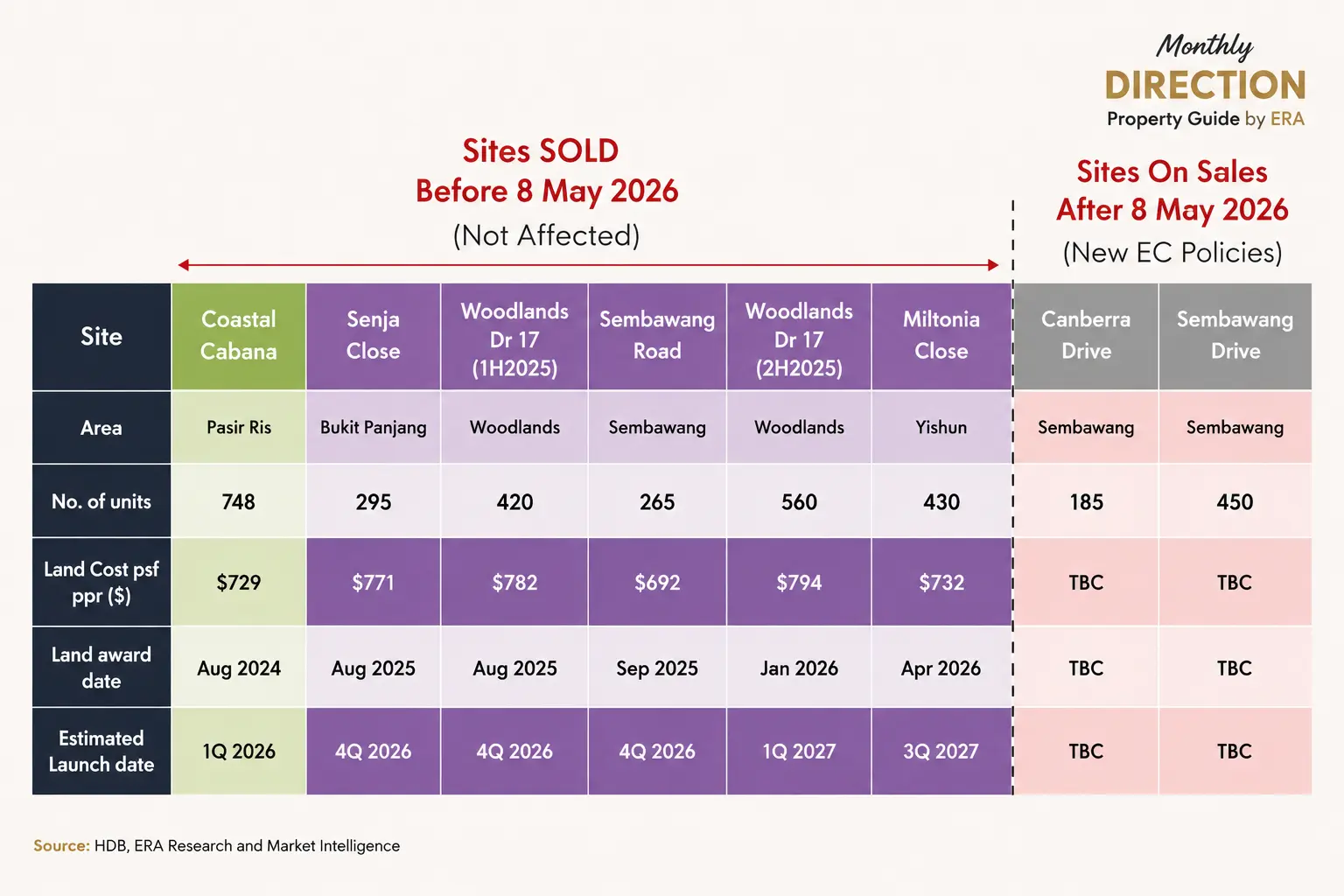
Two knock-on effects are worth planning for. First, developers should bid less for EC land. A 10-year wait and a smaller pool of upgraders both cap the price they can expect on exit. Second, the ECs from land bought before 8 May still launch under the old rules. That list includes Senja Close, Woodlands Drive 17, Sembawang Road and Miltonia Close, all bought at $692 to $794 psf ppr. They are the last of their kind, and I expect buyers to treat them that way. If you are weighing this fork in the road, I set out the mechanics in my EC-to-private upgrade guide.
How fast are government land prices rising, and why does it matter?
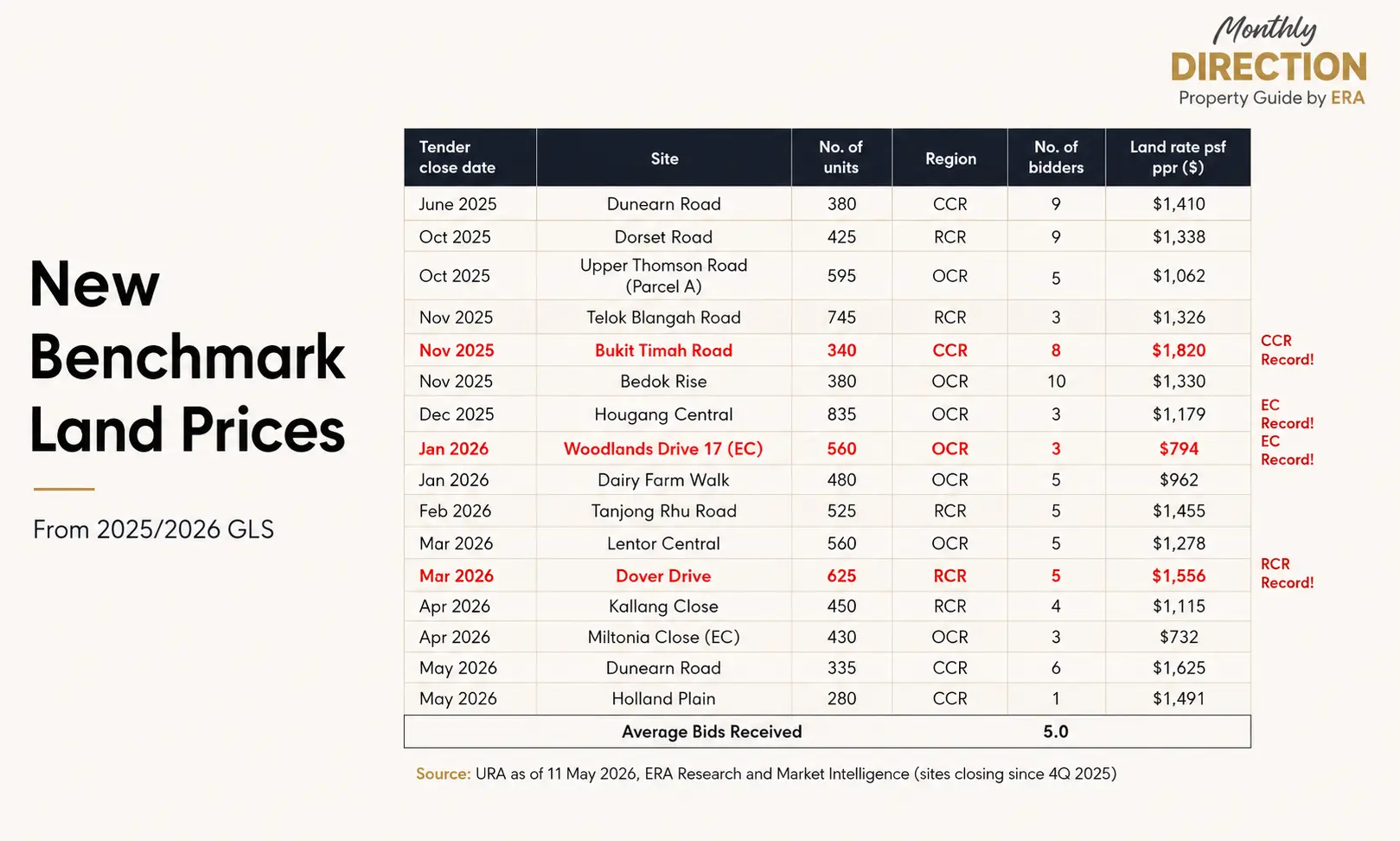
Fast, and it matters because land is the biggest single cost in any new launch. Compare like with like. In Lentor, one OCR plot was awarded at $920 psf ppr in April 2025. The neighbouring Lentor Central plot went for $1,278 psf ppr in March 2026. That is about 39% more in eleven months. We lay out the full seven-tender record, and the resale profits it produced, in our Lentor sub-sale analysis. Along Dunearn Road, two prime plots went from $1,410 in June 2025 to $1,625 in May 2026. Records fell in all three regions: $1,820 psf ppr at Bukit Timah Road in the CCR, $1,556 at Dover Drive in the RCR, and $794 at Woodlands Drive 17 for EC land. Tenders since late 2025 drew about five bidders each. That is competitive but not frantic. Developers appear to believe these prices, not merely chase them.
Buyers have backed that judgement so far. April's launches showed it in a single weekend. Tengah Garden Residences sold 853 units, or 99% of the project, at an average of about $1.86 million, roughly $2,120 psf. Vela Bay sold 371 units, or 72%, on launch day at about $2.35 million, roughly $2,886 psf. Across the whole of April, 1,543 new condo units changed hands at a median of $2,210 psf. Here is the mechanism. Developers buy land two to three years before the showflat opens. They must recover that cost. So when land prices rise and buyers keep turning up, higher launch prices are not a forecast. They are a schedule. Every site above feeds a 2027 or 2028 launch, which is why I spend so much time on GLS site analysis. PropertyInsider's pipeline tracker follows each of these sites with indicative launch ranges, separately from anything I write here.
What does this mean if you want to upgrade from a flat to a condo?
Put the three floors together and one group faces an unusual set-up. If you own an HDB flat and are thinking about private property, every signal currently points the same way.
- More BTO flats are being built. Over time that limits how much further HDB resale prices can climb.
- HDB resale price growth has slowed. The asset you would sell has stopped rising much.
- Land costs are rising. The asset you would buy has a floor being raised at tender, about two years before it reaches the market.
- Private prices are still rising. The gap you must bridge grows each quarter you wait.
- Affordability has held up. Incomes and holding power have not cracked, which is why none of this is reversing yet.
A flat exit price and a rising target price is a closing window, not a crisis. Nothing dramatic happens if you wait a year. You simply pay a bigger difference. And because the new EC rules favour first-timers so heavily, the old HDB to EC to private ladder has lost a rung for second-timers. More of them will end up looking at resale condos and at projects already launched on older, cheaper land.
One last note from outside the housing market, because it completes the picture. Money that cooling measures pushed out of homes is turning up in industrial property, where the Additional Buyer's Stamp Duty does not apply. A recent industrial launch sold out on day one. When money moves rather than leaves, demand for Singapore property has not shrunk. It has changed shape: policy reshaped the bottom and middle, land costs reshaped the top. Read the shape right and 2026 is less confusing than it looks. For the wider backdrop of interest rates, incomes, land and policy in one framework, see my column From noise to clarity: five forces shaping Singapore property in 2026.
I returned to the upgrader question after ERA's July 2026 outlook, that time with our own buyer numbers attached. See A record MOP wave meets a thin launch pipeline.
| Floor | Who it serves | What moved it in 2026 | Key figure |
|---|---|---|---|
| Ground: BTO flats | First-time buyers | Subsidised pricing drew record demand | 9,061 applicants for 3,446 flats |
| Ground: resale flats | Buyers who need a home now | Busy but calm; the tail grabs headlines | 1,941 sales; 7% above $1m |
| Middle: executive condos | The sandwiched middle, and upgraders | Rules rebuilt for land sold from 8 May | 65% of 2025 sellers exited within 10 years |
| Top: private launches | Upgraders and investors | Record land prices feeding future launches | Lentor land +39% in 11 months |
The short version — read this first
Six things worth remembering from everything above.
What we found
- Cheap flats, crowded queueFebruary 2026 drew 9,061 applicants for 3,446 BTO flats. Second-timers faced up to 39.2 applicants per flat in Tampines
- Resale HDB is busy, not wild1,941 sales in April 2026. Half sat between $500,000 and $750,000. Million-dollar flats were 7% of the month
- The EC rulebook changedFor EC land sold from 8 May 2026: you must live there 10 years instead of 5, you pay your loan from the start, and 90% of units go to first-timers for two years
- Why the change happened65% of EC sellers in 2025 sold within 10 years of completion, with average gains of about $606,000 to $806,000
- Land keeps getting dearerLentor land went from $920 to $1,278 psf ppr in eleven months, about 39%. Records fell in all three regions
- The upgrader squeezeThe flat you would sell has stopped rising. The condo you would buy has not. Each year of waiting costs you the difference
So what should you do with this?
- If you are a first-timer: you have never had better odds on a BTO flat or a new EC. Apply.
- If you are a second-timer hoping for an EC: check the 10% allocation before you plan around it, and look at resale ECs and already-launched condos as well.
- If you are an HDB owner thinking about a condo: get your flat valued and ask a banker what you can borrow. Those two numbers, not the headlines, decide whether the window is open for you.
Frequently asked questions
What changed in the EC rules in May 2026?
Three things, for EC land sold from 8 May 2026. You must live in the flat for 10 years before selling, not 5. The Deferred Payment Scheme is gone, so you service the loan from the start. And 90% of units are held for first-timers in the first two years, leaving 10% for upgraders. Sites bought before that date still launch under the old rules. Those include Senja Close, Woodlands Drive 17, Sembawang Road and Miltonia Close.
Are ECs still worth buying under the new framework?
For first-timers, yes. Your odds of getting one at the usual discount just improved a lot. The trade-offs are real. A 10-year wait removes the old profit-taking window, and you pay the loan from day one. A new-rules EC is a long-term home, not a stepping stone. Second-timers will struggle to reach the 10% slice, and should also price up resale ECs and condos already on the market.
How fast are land prices actually rising?
On similar sites, sharply. OCR land in Lentor went from $920 psf ppr in April 2025 to $1,278 in March 2026, about 39% in eleven months. Prime plots along Dunearn Road went from $1,410 to $1,625 over a similar period. New records were set in the CCR ($1,820, Bukit Timah Road), the RCR ($1,556, Dover Drive) and EC land ($794, Woodlands Drive 17).
Why should a home buyer care about GLS tenders at all?
Because land is the biggest cost inside a launch price, and tender results are public 12 to 18 months before the showflat opens. Land bought at record rates through 2025 and 2026 sets a floor under 2027 and 2028 launch prices. That is also why projects already on the market, built on cheaper older land, can be the better value while land costs keep climbing.
Sources: HDB February 2026 BTO application data and pricing; HDB resale transaction data, April 2026; URA resale EC and condominium caveats as of 13 May 2026; URA GLS tender results as of 11 May 2026; URA REALIS as of 17 May 2026; The Straits Times report of 26 April 2026 (launch weekend sales); Business Times; ERA Research and Market Intelligence, Monthly Property Guide, May 2026. Figures reproduced with attribution. EC profit statistics are based on 2025 resale transactions and describe realised historical outcomes, not projected returns.