
In both pairs we tested, the newer launch beat its older neighbour by roughly 20 percentage points over eight years. That held even though it entered $150 to $400 psf above it. Both winners shared three things: a real walk to an MRT station, more than 1,200 units, and an established primary school catchment. Two widely shared claims did not survive checking.
We chose these pairs to control for the thing that usually muddies this question. Compare a launch in one district against resale homes in another and you are measuring location, not whether new beats old. Compare a launch against the completed project next door, sharing the same station and the same school catchment, and you isolate age and product. That is a narrower question. It is also a far more answerable one. The claims that did not hold up are unpacked further down.
Four terms used in this article
- psfPer square foot. A home's price divided by its floor area
- Strata areaThe floor space inside your own home, which is what you pay for
- Floor-area harmonisationA 2023 rule change that stopped some spaces, such as air-con ledges, counting as area you buy
- Survivorship biasWhen you only study the cases that worked out, the weaker outcomes disappear and the average looks better than reality
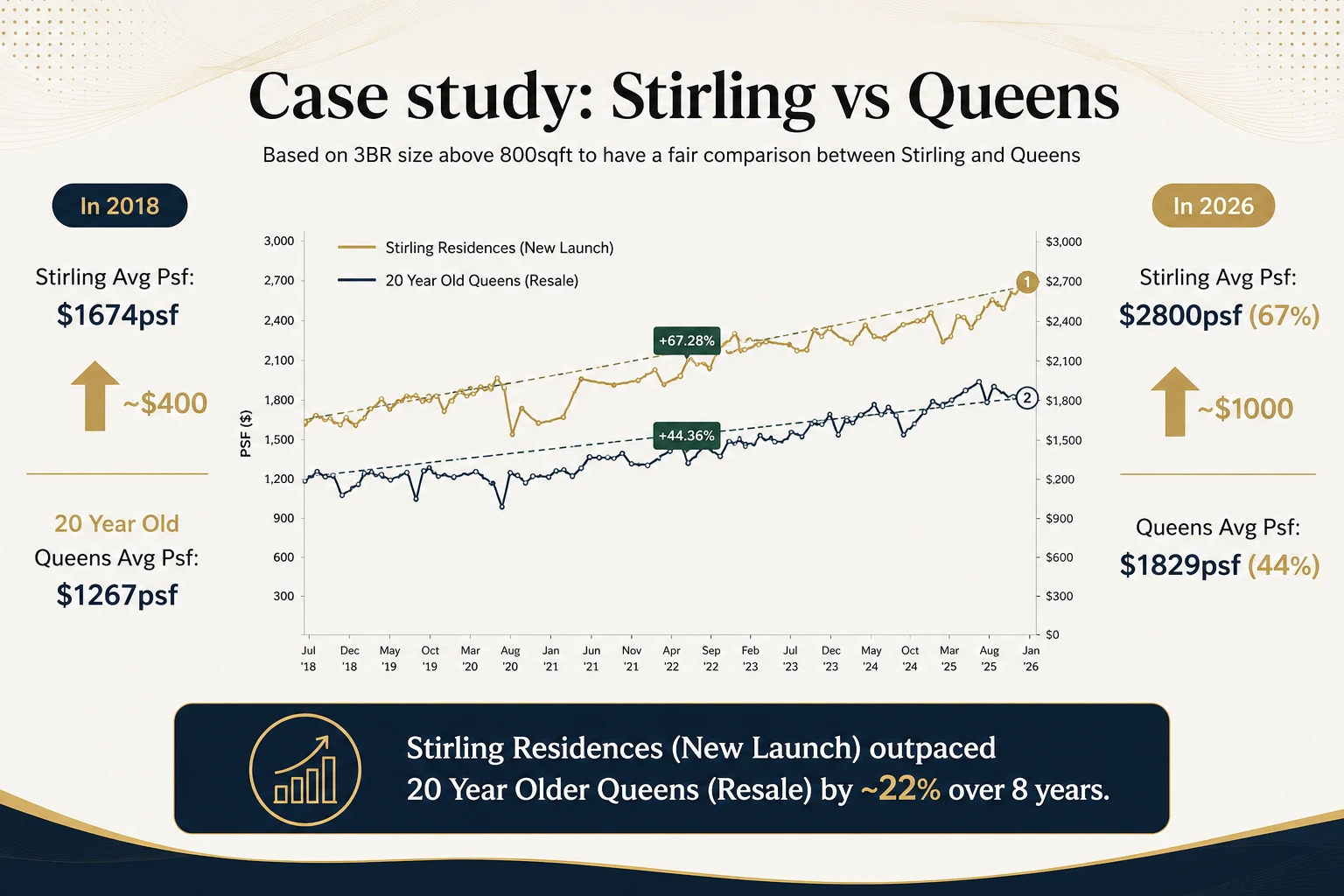
Case study: Stirling Residences against Queens
Two projects in Queenstown, in District 3, near enough to be neighbours. Both are walkable to Queenstown MRT and both sit inside one kilometre of Queenstown Primary School. Stirling Residences was built in 2022 and has 1,259 units. Queens was completed in 2002 with 722 units, twenty years older.
A buyer choosing between them in 2018 faced an uncomfortable premium. Stirling launched at roughly $1,674 psf, against about $1,267 psf for Queens. That is a gap of about $400 psf, or 32%. By 2026, Stirling traded at about $2,800 psf and Queens at about $1,829 psf. Those are gains of roughly 67% and 44%. So the buyer who paid $400 psf more at entry ended up about $970 psf ahead.
Case study: JadeScape against The Panorama
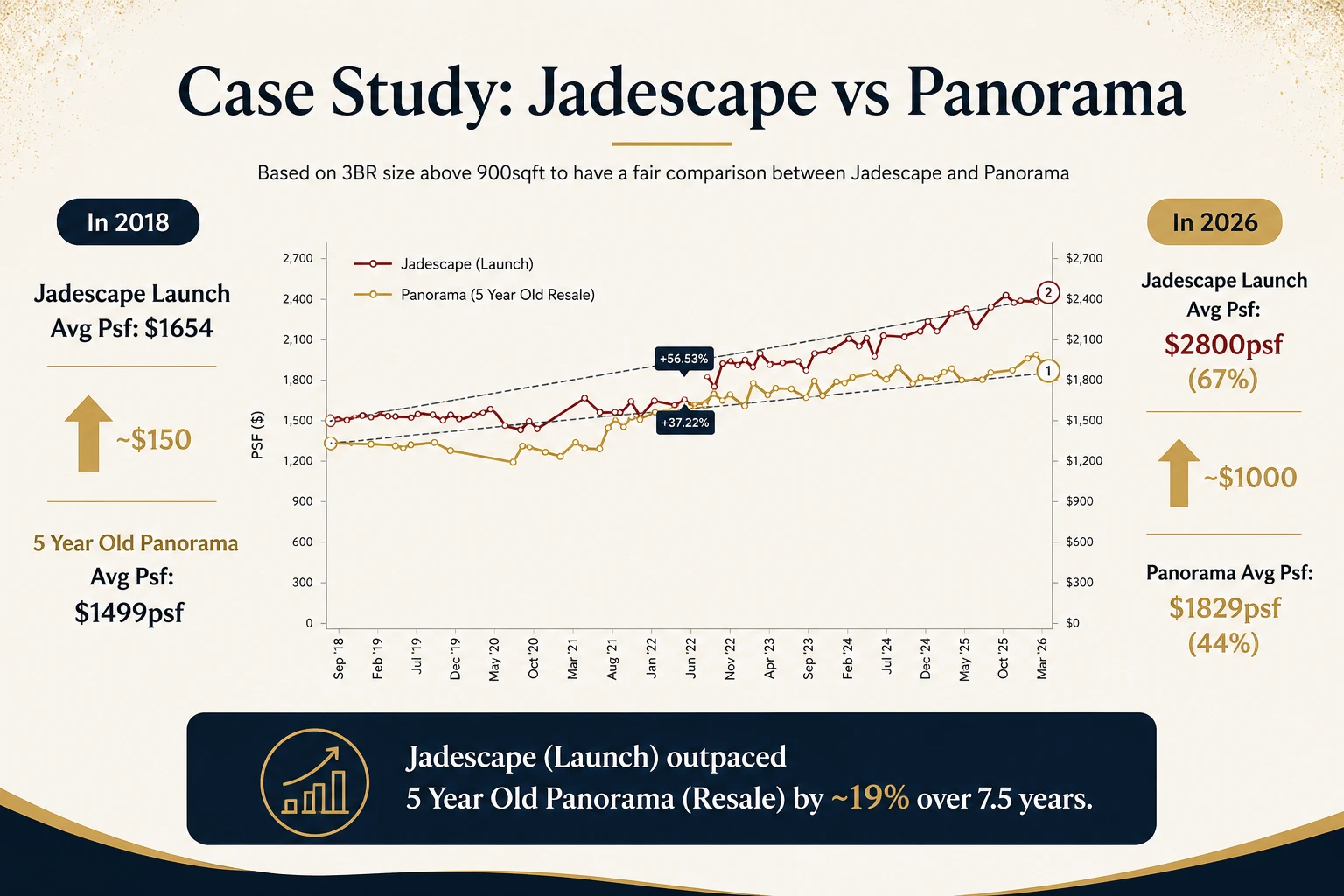
The same test in District 20, with a smaller age gap. JadeScape was completed in 2023 with 1,206 units, near Marymount MRT and inside the Catholic High School catchment. The Panorama was completed in 2017 with 698 units, near Mayflower MRT and St Nicholas Girls' School.
The entry premium was much smaller here. JadeScape launched at roughly $1,654 psf against about $1,499 psf, a gap of just $150 psf. By 2026, JadeScape traded around $2,589 psf and The Panorama $2,057 psf. Those are gains of roughly 57% and 37%, a spread of about 20 percentage points.
What did the two winners have in common?
Both pairs point to the same short list. Stirling and JadeScape were each walkable to an MRT station. Each held more than 1,200 units. And each sat inside an established primary school catchment. Their older neighbours shared the location, but not the size or the length of lease left.
Size deserves a note, because buyers dismiss it most often. A 1,200-unit development produces enough sales to set its own price benchmark. That gives a future seller a ready market. A 200-unit project in the same postcode can go whole quarters without a single comparable sale. Then its valuation depends on whatever the last transaction was, even if that one was unusual.
How do you pick a new launch that performs?
Run it through four filters. This matters more than the new-versus-resale decision itself, because this is where the variation lives. If a project fails two or more filters, you need an explicit reason why it is an exception.
-
Filter 1Is it within a genuine walk of an MRT station?
- Under 500m → PassRecurred in both winning pairs and hardest to compensate for. Verify the route on a map, not a marketing radius.
- Over 800m → Needs a reasonSomething else must carry it: a school catchment, a committed line, or pricing well below comparable land cost.
-
Filter 2Is the development large enough to be liquid?
- Over ~500 units → PassEnough transactions for a benchmark and a buyer pool at exit. Both winners had more than 1,200 homes.
- Under ~200 units → CautionThin comparables cut both ways: scarcity premium in a good market, valuation vacuum in a bad one.
-
Filter 3Is the entry price defensible against land cost?
- In line → PassLand cost anchors what a developer must charge. Our pricing methodology shows how we work this out. The GLS pipeline tracker holds the land prices.
- Well above → Reprice or walkStirling's $400 psf premium worked because location and scale did the work, not because premiums generally work.
-
Filter 4Is there a school catchment already, or new transport on the way?
- Established → PassCheck the 1km and 2km rings on our primary schools map; the demand pattern is in our school demand analysis.
- Announced only → Discount itA date for new infrastructure is a target, not a promise. Price the project as it is today.
One filter is missing on purpose. We do not tell you to hunt for the cheapest unit. The cheapest stack in a well-chosen project has historically beaten the best stack in a badly chosen one. The reason is simple. The project sets the ceiling. The stack only decides where you sit under it. Transaction counts by project are in our price trends explorer.
Does buying on launch day guarantee a paper gain?
No. Developers do release stock in batches and raise the price list as units clear. So early buyers generally pay less than late buyers for comparable homes. But the two most-cited recent examples both need unpacking.
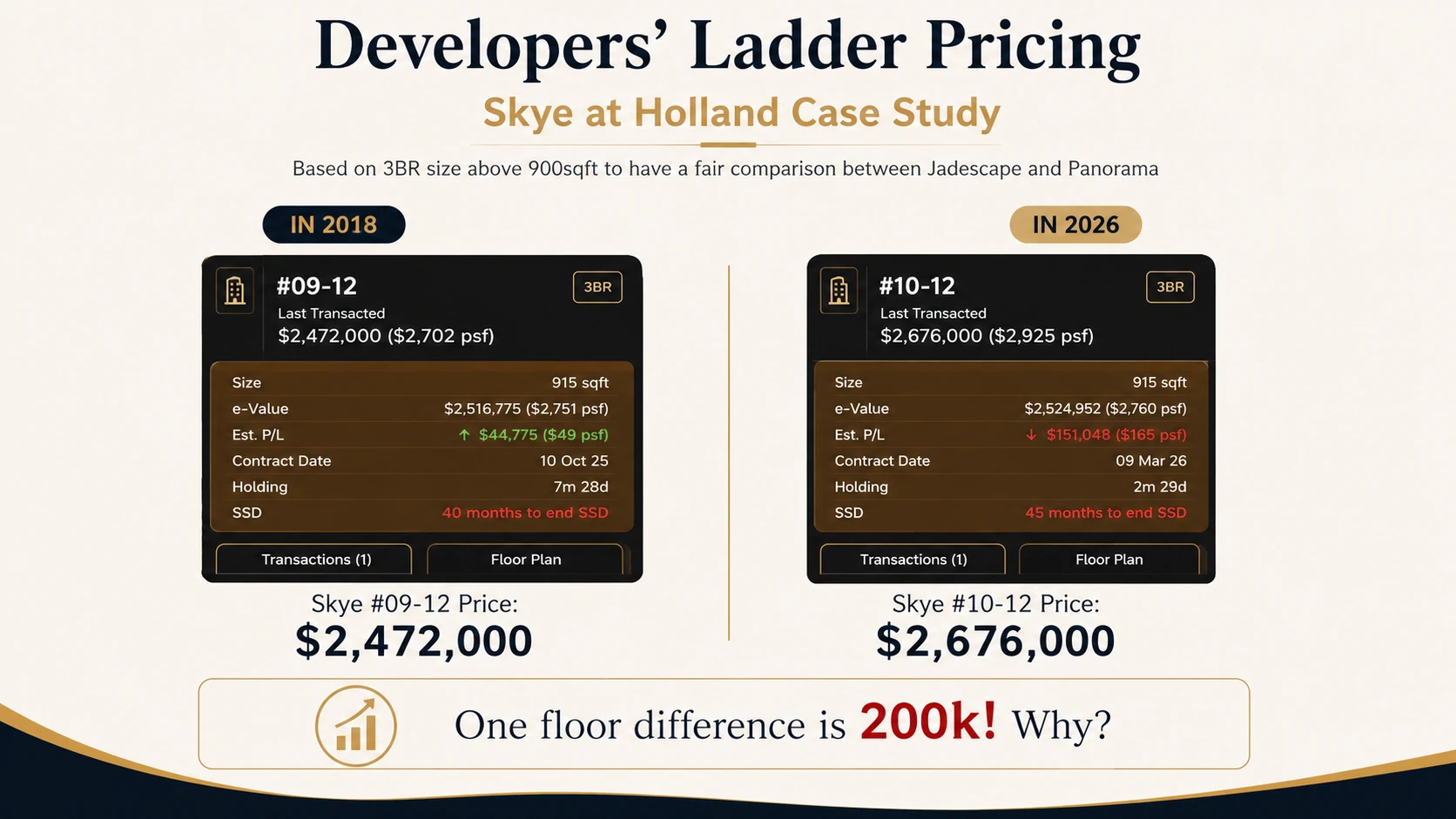
Take Skye at Holland in District 10. It sold 658 of 666 units on its launch day of 11 October 2025, at an average of $2,953 psf. A ninth-floor three-bedroom sold at $2,472,000, or $2,702 psf. The unit directly above it, re-released after a buyer dropped out, went for $2,676,000, or $2,925 psf, in March 2026. That $204,000 gap gets quoted as proof of a floor premium. It is not. One floor typically adds around $10 psf. And the launch-day unit sold roughly $250 psf below the project's own launch average. So most of the gap is a cheap day-one price meeting a reprice toward market five months later. The valuation model in the same screenshot reads the later buyer as about $151,000 above estimated value.
Now take Aurelle of Tampines. It launched on 8 March 2025 at $1,766 psf and sold out by 12 April. An 872 sq ft three-bedroom booked at $1,523,000 was re-released a year later at $1,789,000. That is $266,000, or 17.5%, on the same unit. Two caveats. First, this is an EC, not a private condo. It has income limits, a minimum stay rule and cheaper state land. So it tells you little about private launches. Second, a fully sold project has no remaining stock to price against. That is exactly why a returned unit clears high.
The durable version of the early-entry argument is about downside, not upside. One Amber in District 15 launched at about $925 psf. It reached roughly $1,390 psf by completion, and traded around $2,334 psf by April 2026. That is some 152% above launch. Its path crossed the 2008 financial crisis before the building was even finished. A buyer at $925 psf had a cost base low enough to come through that fall intact. A buyer who entered at completion pricing did not. That is the real content of the phrase "price support". It is a statement about your entry price, not about buying from a developer.
Why is comparing price per square foot across 2023 misleading?
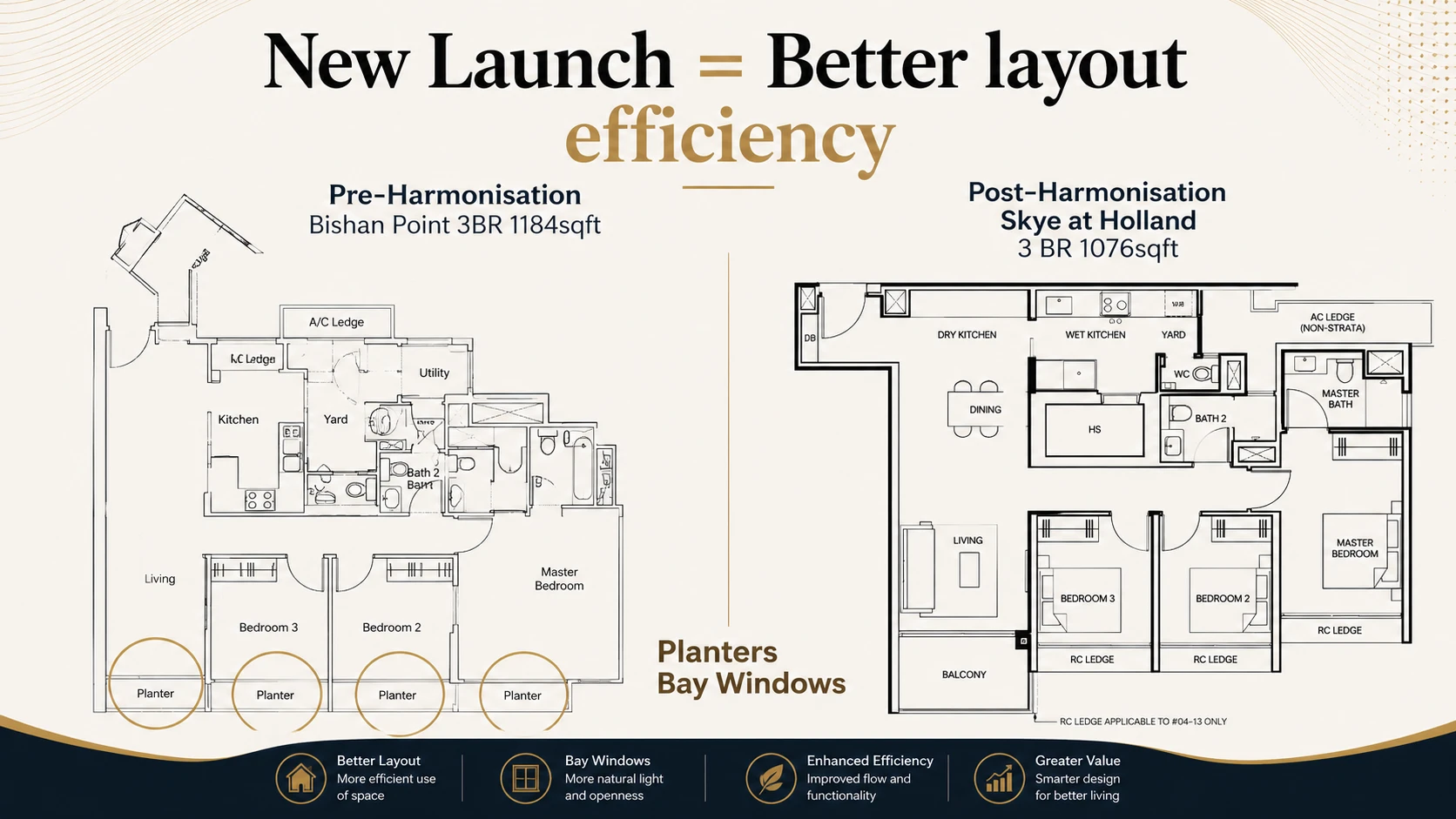
Because the rules for measuring floor area changed. URA, SLA, BCA and the SCDF brought their definitions into line, applying to development applications from 1 June 2023, and to state land put up for sale from September 2022. Internal voids no longer count as area you buy. Air-con ledges kept as shared space no longer count either. Older projects could count balconies, planters, bay windows and ledges as space you bought. That was especially true of projects approved under the 2009 bonus floor area scheme.
This changes how you should read every price above. A 1,076 sq ft three-bedroom measured under the new rules contains more usable space than an older three-bedroom of 1,141, or even 1,184 sq ft, carrying two balconies, a run of planters and a strata-included air-con ledge. So some of the apparent new-launch premium in these comparisons is not a premium at all. Any price series crossing the June 2023 cutoff is not measuring one consistent product.
Do newer condos command higher rents?
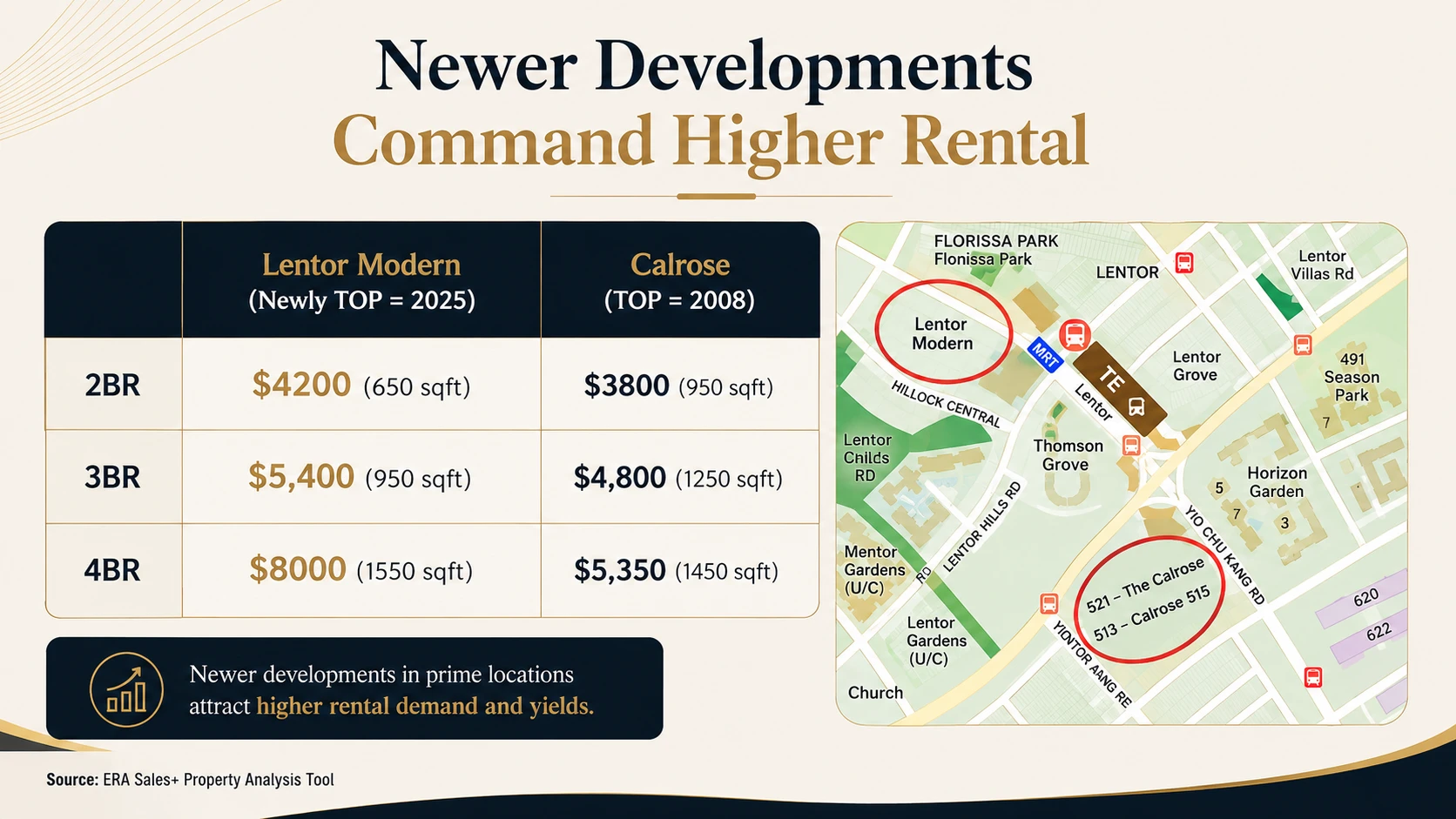
In the Lentor comparison, yes, and by more than size alone explains. At Lentor Modern, completed in 2025, a 950 sq ft three-bedroom achieved about $5,400 a month. At The Calrose, completed in 2008, a larger 1,250 sq ft three-bedroom achieved about $4,800. Per square foot that is roughly $5.68 against $3.84, a gap near 48%. The four-bedroom gap was wider still. This is part of the mechanism behind the price outperformance above. A newer home that rents better also supports a higher price for the next buyer.
How should you use this alongside the decision itself?
This study answers what happened, and why. It does not answer whether you should buy new or completed. That depends on when you need the keys, whether you need rental income, and how four years of costs compare on your own numbers. Our new launch versus resale guide works that decision through, with a flowchart and a four-year cost comparison at a $2.5 million budget. For the payment mechanics once you have chosen a launch, see buying a new launch condo. For how much you can borrow, see our TDSR guide. For the order to do things in when upgrading, see selling your HDB to buy a new launch. Land rates for projects still to come sit in the GLS pipeline tracker, prices and realised gains in the price trends explorer, and the calculators in the tools section.
| Pair | Launch price (year) | Older neighbour | 2026 price | Gain |
|---|---|---|---|---|
| Stirling Residences (D3, 1,259 units) | $1,674 psf (2018) | Queens, 2002, 722 units | $2,800 psf | +67% |
| Queens (D3, comparison) | $1,267 psf (2018 resale) | — | $1,829 psf | +44% |
| JadeScape (D20, 1,206 units) | $1,654 psf (2018) | The Panorama, 2017, 698 units | $2,589 psf | +57% |
| The Panorama (D20, comparison) | $1,499 psf (2018 resale) | — | $2,057 psf | +37% |
The short version — read this first
Six things to take away.
What we found
- The headlineIn both pairs, the newer launch beat its older neighbour by roughly 20 percentage points over eight years
- What the winners sharedA real walk to an MRT station, more than 1,200 units, and an established primary school catchment
- The premium was not the causeStirling buyers paid $400 psf more and exited $970 psf ahead. But location, size and schools did that work
- Launch day is no guaranteeThe famous "one floor, $204,000" example at Skye at Holland mostly measures a price rise over five months, not floor height
- Newer rents betterAt Lentor Modern a smaller three-bedder rented for more than a larger one next door, a gap near 48% per square foot
- Our own honest limitWe picked these pairs knowing the outcome. They show a premium can be recovered, not how often it is
So what should you do with this?
- Run any project you like through the four filters below. Treat two or more failures as a reason to ask hard questions.
- Check the walk to the station on a map, not on a marketing radius drawn as a circle.
- Be careful comparing price per square foot across 2023. The rules for measuring floor area changed, so you are not comparing the same product.
Frequently asked questions
Did new launch condos outperform nearby resale condos in Singapore?
In the two pairs examined here, yes, by roughly 20 percentage points over eight years. Stirling Residences launched in 2018 at about $1,674 psf. Queens next door sat at about $1,267 psf. By 2026 it reached about $2,800 psf against $1,829 psf, gains of 67% and 44%. JadeScape launched at about $1,654 psf against The Panorama at $1,499 psf, reaching about $2,589 psf against $2,057 psf, gains of 57% and 37%. But we picked both pairs already knowing the outcome. So they show that a launch premium can be recovered. They do not show how often it is.
What did the outperforming new launches have in common?
Three things showed up in both. Each was within a genuine walk of an MRT station. Each held more than 1,200 units. And each sat inside an established primary school catchment. Their older neighbours shared the location but not the size or the remaining lease. Size matters because a 1,200-unit development produces enough sales to set its own price benchmark, and to give a future seller a ready market.
Is paying a premium for a new launch worth it?
Buyers got it back in both cases here. But that only worked because the other three things were in place. Stirling buyers paid about $400 psf, or 32%, above Queens in 2018, and exited about $970 psf ahead by 2026. JadeScape buyers paid only about $150 psf more than The Panorama. They still finished about 20 percentage points ahead. So the premium is not what produced the result. The station, the size and the school catchment did.
Does buying on launch day guarantee a paper gain?
No. At Skye at Holland, which sold 658 of 666 units on its launch day of 11 October 2025 at an average of $2,953 psf, a ninth-floor three-bedroom sold at $2,472,000. The unit directly above went for $2,676,000 five months later. That $204,000 gap is not a floor premium. One floor typically adds around $10 psf, and the launch-day unit sold roughly $250 psf below the project's own launch average. A revised developer price list is not a valuation.
What is new launch price support?
It describes a low entry cost, not any guarantee from the developer. One Amber in District 15 launched at about $925 psf, reached roughly $1,390 psf by completion, and traded around $2,334 psf by April 2026. Its price path crossed the 2008 financial crisis before completion. A buyer at $925 psf had a cost base low enough to come through that fall intact. A buyer entering at completion pricing did not.
Why is comparing price per square foot across 2023 misleading?
Because the way floor area is measured changed. URA, SLA, BCA and the SCDF brought their floor area definitions into line, applying to development applications from 1 June 2023. Internal voids no longer count as area you buy, and air-con ledges kept as common property no longer count either. Older projects could count balconies, planters, bay windows and ledges as space you bought. So a 1,076 sq ft home measured the new way contains more usable space than an older home of the same quoted size.
Do newer condos command higher rents than older ones?
In the comparison examined here, yes, and by more than size explains. At Lentor Modern, completed in 2025, a 950 sq ft three-bedroom achieved about $5,400 a month. At The Calrose, completed in 2008, a larger 1,250 sq ft three-bedroom achieved about $4,800. Per square foot that is roughly $5.68 against $3.84, a gap near 48%. Rents vary by stack, condition and when the lease was signed, so treat these as indicative.
Update history
- Study published. Skye at Holland launch data verified against the UOL and CapitaLand Development announcement of 11 October 2025; Aurelle of Tampines against its 8 March 2025 launch and 12 April 2025 sell-out. Paired psf figures are source-material figures, indicative, and not independently recomputed from caveat data.
Methodology & sources. Figures are as of July 2026 unless otherwise dated. Each pair compares a new launch against a completed project sharing broadly the same locality, MRT access and school catchment, so that age and product are the main variables rather than location. Project-level psf figures are as presented in the source material, are indicative, and have not been independently recomputed from URA caveat data; unit counts, completion years and tenure are as stated in the same material. Launch-day sales figures for Skye at Holland and Aurelle of Tampines are from the developers' public announcements. Floor area treatment follows the harmonisation of floor area definitions by URA, SLA, BCA and the SCDF. Rental figures are indicative for comparable bedroom types.
Disclaimer. This study is research and education. It is not financial, legal, tax or property advice, and nothing here is a recommendation to buy or sell. We picked these pairs already knowing how they turned out. That is survivorship bias: they show a launch premium can be recovered where the attributes support it, not how often that happens. Part of the measured outperformance is simply an age effect, available to any newer building, rather than a launch effect. Both launches also entered in 2018 and rode a strong 2020 to 2024 market. Past price movements do not predict future returns, and no checklist can make a purchase safe. The publisher's related interests are disclosed in our editorial policy.