
Neither route is reliably better. The project you pick matters far more than the type you pick. A new launch suits buyers who can wait three to five years for keys and want a brand-new unit, covered by a defects warranty. A resale condo suits buyers who need to move in or rent it out now, and who want more floor space per dollar. Results inside the new launch group have varied hugely. The launches that beat their older neighbours all shared three things: a walk to an MRT station, enough units to stay easy to sell, and an established primary school nearby.
The usual version of this debate compares averages. Averages are the wrong tool here. A launch beside an MRT interchange, in a large development that is easy to sell out of, is a different asset from a small launch on a road with no station. Fold both into one category and you throw away the very thing that decides your outcome. So this guide turns the question around. What did the winners have in common? The method is simple: compare neighbouring projects, where the location is roughly the same and age is the main difference.
What actually differs between the two?
Ten differences do the real work. Every other argument you will hear is decoration on one of these rows.
| Dimension | New launch (under construction) | Resale (completed) |
|---|---|---|
| When you get keys | 3–5 years, at Temporary Occupation Permit | 8–12 weeks after Option to Purchase |
| Payment structure | Progressive payment tied to construction milestones | Full instalment from month one |
| What you inspect first | Showflat and floor plan only | The exact unit, view, noise, neighbours and management |
| Rental income | None until TOP | From completion of the sale |
| Renovation on entry | $15,000–$30,000 (est.) | $60,000–$190,000 (est.), ~1,000 sq ft 3-bedroom |
| Defects cover | Defects liability period, typically 12 months from TOP | None. Sold as inspected |
| Quoted floor area | Voids and common-property ledges excluded | Pre-2023 projects may include balconies, planters, ledges |
| Price formation | Developer price list, revised upward as stock clears | Negotiated against recorded transactions on the same stack |
| Lease remaining | Full 99 years, or freehold | 99 years less age; decay accelerates past year 40 |
| Interim housing | Rent or stay put for 3–5 years | Move in directly |
Which route fits your situation?
Your constraints will narrow this faster than your preferences. If any question below settles it, the rest matter less.
-
Question 1Do you need somewhere to live, or a tenant paying, within the next 12 months?
- Yes → ResaleA new launch cannot house you, or a tenant, for three to five years. If your lease is ending, or the mortgage needs rent from day one, the decision is made for you.
- No → ContinueBoth routes remain open.
-
Question 2Is your priority usable floor area, or a brand-new unit?
- Floor area → ResaleAt the same budget, a completed unit almost always gives you more square feet. A large family feels that every day.
- New unit → New launchNew fittings, a layout designed to current standards, a defects warranty, and the lowest upkeep for years.
-
Question 3Could you be forced to sell within four years?
- Possibly → NeitherSeller's Stamp Duty is the tax for selling too soon. It runs 16%, 12%, 8% and 4% across years one to four, for homes bought from 4 July 2025. On $2.5 million, selling in year two costs $300,000.
- No → New launch viableYou would sit out the construction period anyway, and that uses up most of the four-year tax window.
Question 1 settles it for most buyers. If both routes are still open for you, the rest of this guide tackles the harder question: which specific project.
Did new launches actually outperform nearby resale condos?
Sometimes, and the pattern is specific enough to be useful. We looked at two pairs, one in District 3 and one in District 20. In both, the newer launch beat its older neighbour by roughly 20 percentage points over eight years. That is despite entering $150 to $400 psf above it. Both winners shared three things. A real walk to an MRT station. Enough units to stay easy to sell when you exit. And an established primary school nearby.
Those cases carry dated psf figures, so they live in a separate study rather than here. Our four paired case studies set Stirling Residences against Queens, and JadeScape against The Panorama. They also track the developer price ladder at Skye at Holland and Aurelle of Tampines, and One Amber through the 2008 fall. The study then turns what the winners shared into a four-point checklist. Read it next if both routes are still open to you. The project has mattered more than the type.
Where does a resale unit win?
Three advantages are built in. They get underweighted because they are hard to put on a slide.
It earns or houses you immediately. Take a $2.5 million unit renting at $5,000 a month. Four years of tenants is roughly $240,000 of rent. A project under construction pays you nothing.
You buy the actual unit. You see the stack, the afternoon sun, the road noise, the sinking fund balance, and how well the building is managed. A showflat shows you a specification. A viewing shows you a home.
You can check the price. A resale price is negotiated against recorded sales on the same stack. A launch price is set by the seller. So the price you are handed to compare against is the developer's, not the market's.
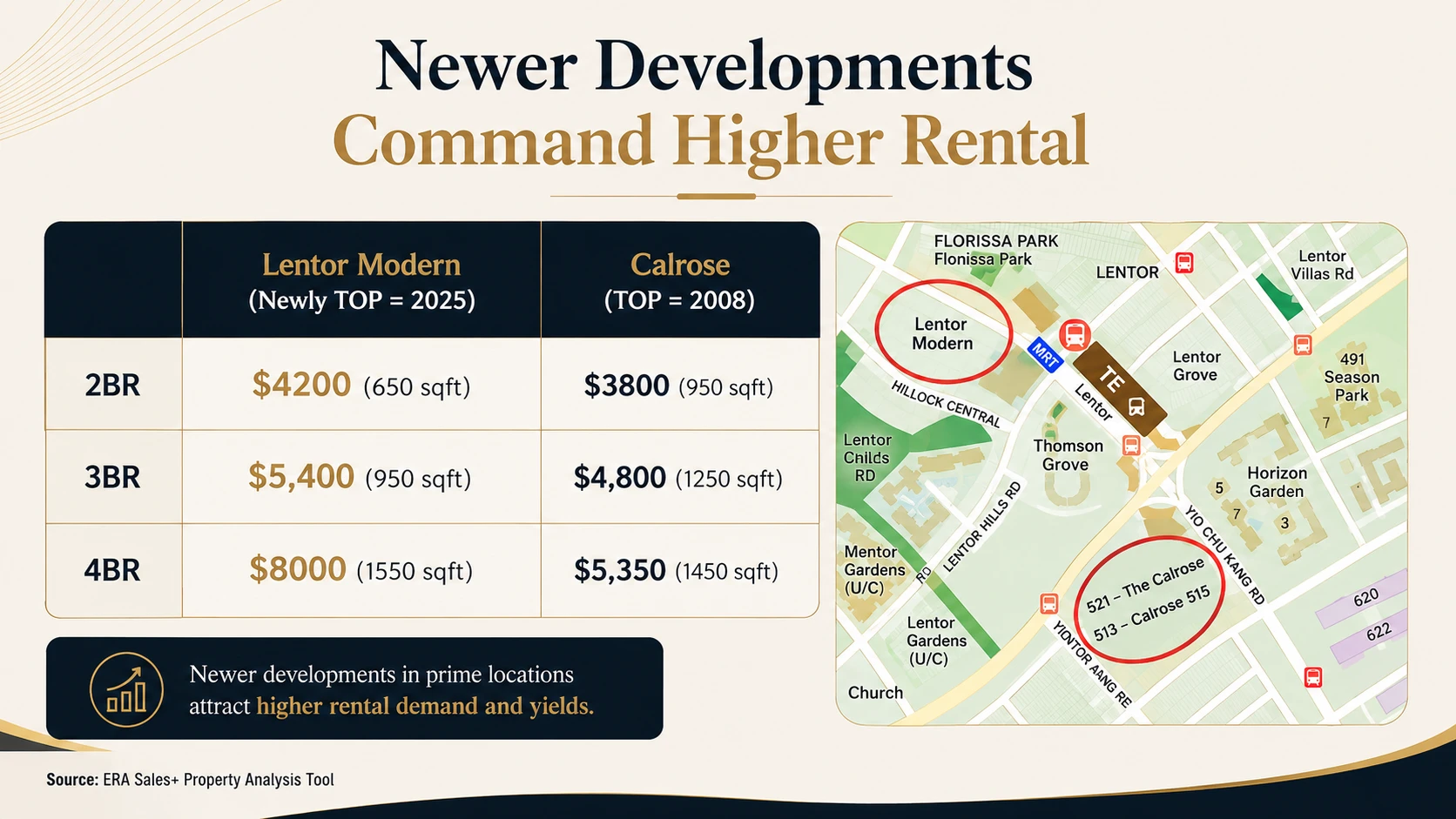
There is a counterweight: newer units rent for more, by more than size explains. At Lentor Modern, completed in 2025, a 950 sq ft three-bedroom achieved about $5,400 a month. At The Calrose, completed in 2008, a larger 1,250 sq ft three-bedroom achieved about $4,800. Per square foot that is roughly $5.68 against $3.84, a gap near 48%.
Why is the price per square foot not comparable?
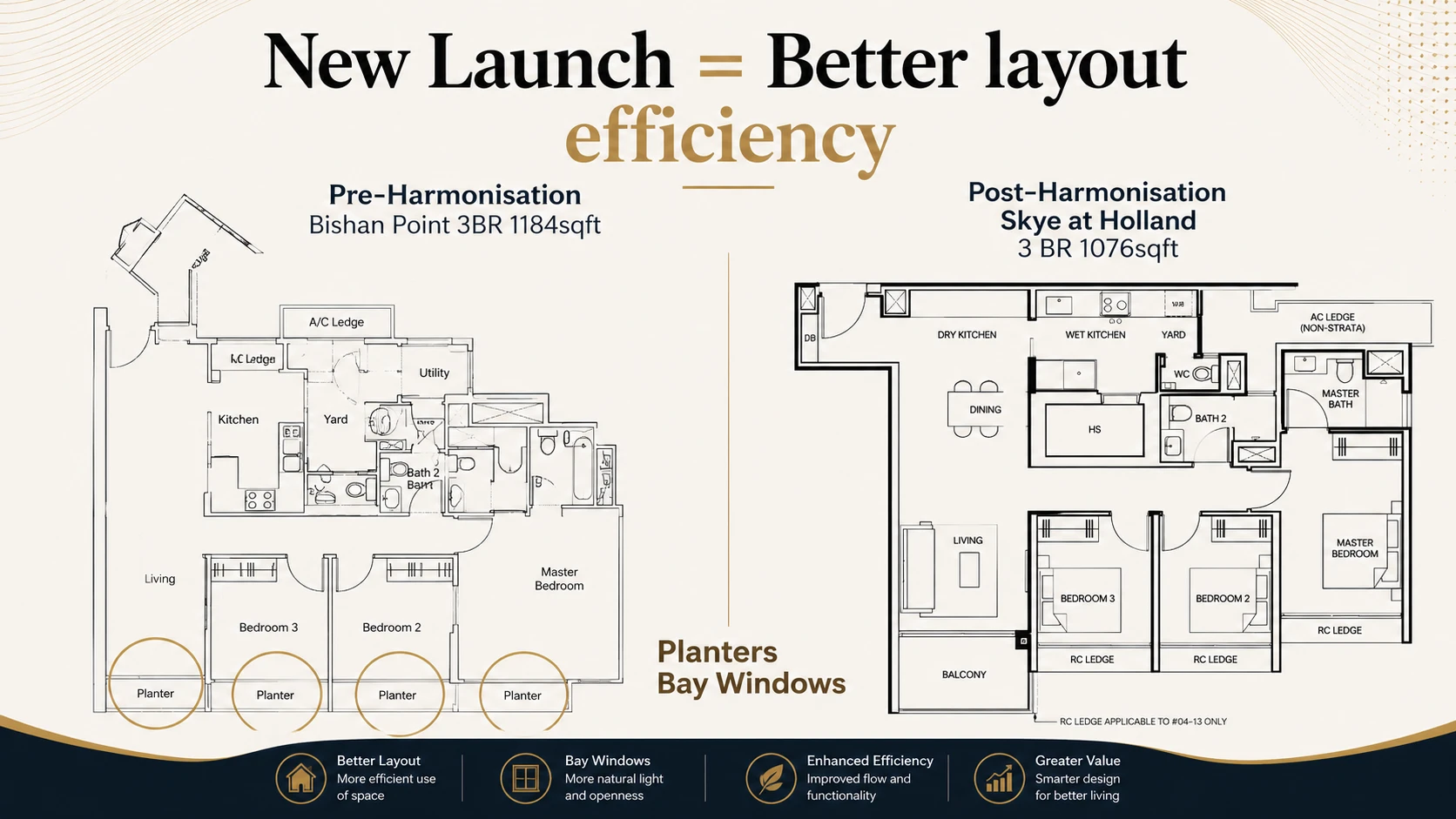
The rules for measuring a unit changed. URA, SLA, BCA and the SCDF agreed one common definition of floor area. It applies to development applications from 1 June 2023, and to government land sale sites launched from September 2022. Under it, internal voids no longer count in the area you buy. Nor do air-conditioner ledges kept as common property. Older projects worked differently. Especially those approved under the 2009 bonus floor area scheme, which could sell balconies, planters, bay windows and ledges inside the quoted area.
Read this as a measuring caution, not a profit forecast. A newer 1,076 sq ft three-bedroom holds more usable space than an older 1,141 sq ft one, or even an 1,184 sq ft one, if the older unit carries two balconies, a planter run and an aircon ledge inside its quoted area. So some of the apparent new-launch premium is not a premium at all.
What does four years of each actually cost?
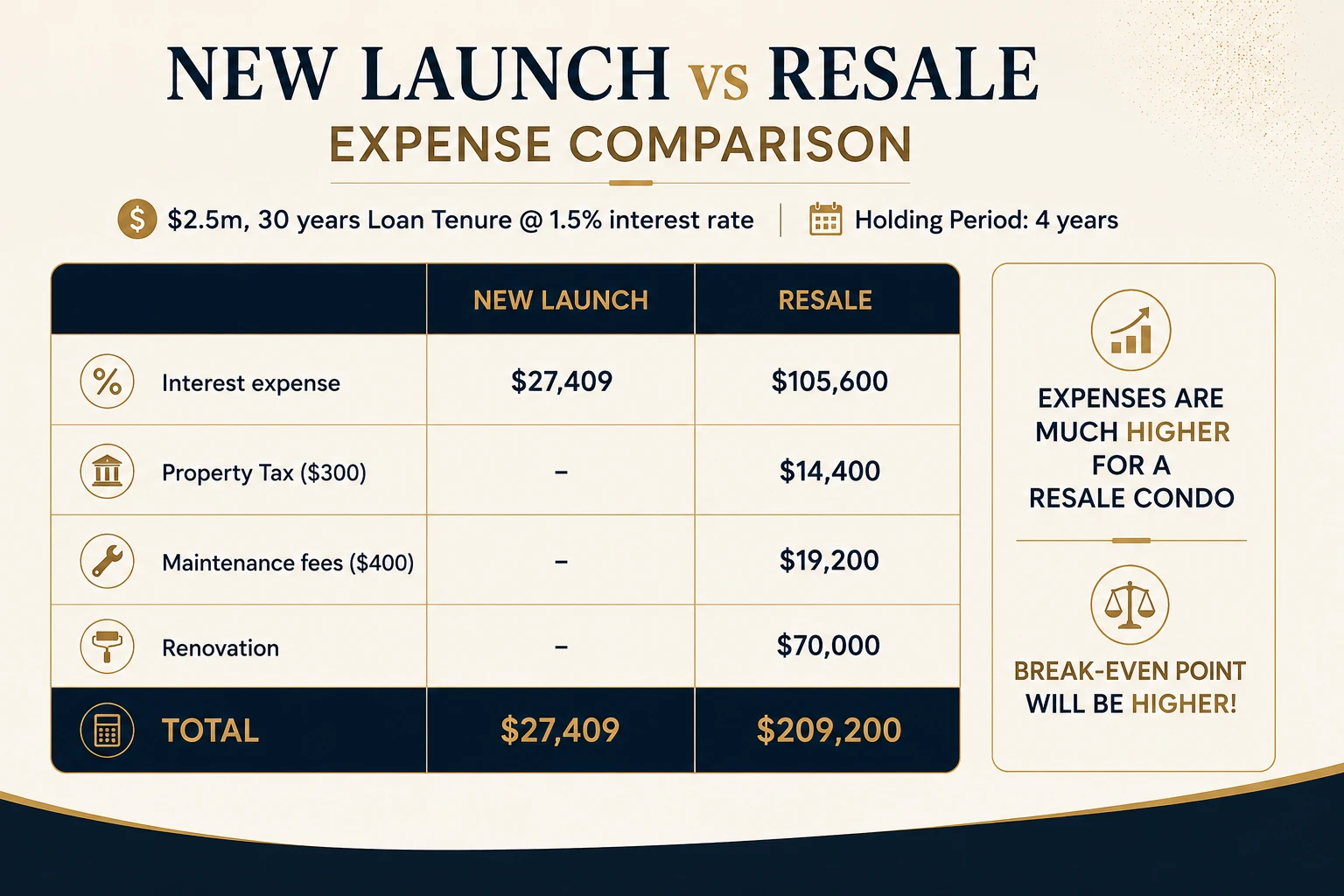
One scenario, applied to both routes. A $2,500,000 purchase at 75% loan-to-value. That is a $1,875,000 loan over 30 years, at 1.5% a year, held for four years. Buyer's Stamp Duty is the same at the same price, so it cancels out. Our stamp duty calculator will size it, including any Additional Buyer's Stamp Duty.
| First 48 months | New launch | Resale |
|---|---|---|
| Mortgage instalments paid | $76,300 | $310,600 |
| Of which interest | $27,400 | $106,600 |
| Property tax and maintenance (est.) | — | $33,600 |
| Renovation (est.) | $20,000 | $70,000 |
| Interim housing, own-stay (est.) | $216,000 | — |
| Cash out, own-stay buyer | $312,300 | $414,200 |
| Economic cost, own-stay (excl. principal) | $263,400 | $210,200 |
| Gross rent received, investor (est.) | — | ($240,000) |
| Economic cost, investor (excl. principal) | $47,400 | ($29,800) |
Two things move this most. The interest rate. At 1.5% the resale investor is ahead on running costs. But packages we track in mid-2026 run from about 1.35% to above 1.9%. A higher rate hurts the resale faster, because the whole loan is drawn from month one. The build period. A five-year construction adds a year of rent you pay to the launch column, and a year of rent you collect to the resale column. Run your own figures in the new launch ROI calculator.
What mistakes do people make in this comparison?
- Comparing categories instead of projects. The spread inside the new launch group is wider than the gap between groups. "Is a launch better than resale" cannot be answered. "Is this launch better than that resale" can.
- Treating a delay as a discount. Stage payments change when you pay, not how much. If you will pay rent during construction, that rent belongs in the launch column.
- Mixing two ways of counting. Setting a launch's interest-only figure against a resale's full instalment, plus maintenance, plus renovation, is not a comparison. Pick one method and apply it to both sides.
- Reading a new price list as a valuation. A gain on paper is not a gain until similar units actually sell at that price. And treat Stirling and JadeScape as useful for what they shared, not as proof of how often this happens. Two examples cannot tell you that.
- Budgeting on the construction-phase instalment. In the table above it starts near $470 and reaches $6,471 once the loan is fully drawn. Banks test you at 4%, not at your package rate. See our TDSR guide.
We deliberately do not freeze the fastest-moving figures here. Current loan packages sit in our mortgage rates table. Shortlisted projects sit in the new launches section and the new launch comparison tool. For how the payments work, read buying a new launch condo. For the order to sell and buy in, read selling your HDB to buy a new launch. For where we are in the cycle, read our buy, wait or upgrade analysis. Every calculator sits in the tools section.
The short version
What to remember
- Which type wins as a categoryNeither. The project decides
- What settles it for most buyersWhether you need to live there within 12 months
- What every winning launch sharedMRT walk, scale, established school
- Four years, counting cash outLaunch about $102,000 lighter
- Four years, counting money you never get backResale about $53,000 cheaper
- Rent a resale earns over those four yearsAbout $240,000 at $5,000 a month
- Rent gap, new against 2008-vintageNear 48% per square foot
- Cost of selling in year two on $2.5M$300,000 in Seller's Stamp Duty
So what should you do with this? Answer the first flowchart question honestly, because it decides most cases on its own. If both routes stay open, stop comparing types and start comparing two named projects. Check the launch against the three things every winner shared, and price four years of each on one consistent basis, not two. Our new launch comparison tool sets projects side by side, and the ROI calculator runs the four-year cost on your own numbers.
Frequently asked questions
Is a new launch or a resale condo better in Singapore?
Neither is reliably better. The project you pick matters far more than the type. A new launch suits buyers who can wait three to five years for keys, and who want a brand-new unit under a defects warranty. A resale condo suits buyers who need to move in or rent it out now, and who want more floor space per dollar. Results have varied hugely between projects inside the new launch group.
Which new launches outperformed nearby resale condos?
Two documented pairs illustrate the pattern. Stirling Residences launched in 2018 at about $1,674 psf, roughly $400 above neighbouring Queens at $1,267 psf, and by 2026 reached about $2,800 psf against $1,829 psf, a 67% gain against 44%. JadeScape launched at about $1,654 psf against The Panorama at $1,499 psf, reaching about $2,589 psf against $2,057 psf, a 57% gain against 37%. Both launches shared MRT proximity, large unit counts and established school catchments.
What should I look for when picking a new launch?
Four things separated the launches that did well. A walking distance to an MRT station. A development large enough to sell out of easily. An established primary school nearby. And an entry price checked against comparable land cost, not against the developer's story. No single one is enough on its own. The hardest gap to make up has been a missing MRT station.
How much cheaper is a resale condo per square foot?
The gap varies by area, and part of it is not real. The rules for measuring a unit changed for development applications from 1 June 2023. Internal voids and common-property aircon ledges no longer count in the area you buy. So a newer 1,076 sq ft unit holds more usable space than an older one of the same quoted size. Comparing price per square foot across that cutoff overstates the gap.
Does buying on launch day guarantee a gain on paper?
No. Developers do raise list prices as units clear. At Skye at Holland, a re-released three-bedroom sold for $2,676,000 in March 2026, against $2,472,000 for the unit directly below it in October 2025. But that $204,000 gap mixes three things together: one floor of height, five months of price rises, and the fact that the launch-day unit sold at $2,702 psf, well below the project's $2,953 psf launch average. A revised price list is not a valuation.
Does Seller's Stamp Duty affect new launch buyers differently?
The rule is the same, but the effect differs. For homes bought on or after 4 July 2025, IRAS charges 16%, 12%, 8% and 4% across years one to four, counted from the purchase date. A new launch buyer sits out most of that window while the project is built, so the tax-free date often arrives near completion. A resale buyer lives in it or rents it out throughout, so selling early carries a real tax cost.
Update history
- Plain-English rewrite for first-read clarity. Added a "short version" summary, shortened the title and meta description, and explained the floor area harmonisation and Seller's Stamp Duty rules in full at first mention. No figures, cases or conclusions changed.
- Guide published. Case study psf figures are source-material figures, indicative. Skye at Holland verified against the developers' 11 October 2025 announcement; Aurelle of Tampines against its 8 March 2025 launch and 12 April 2025 sell-out. Cost comparison at $2,500,000, 75% LTV, 30 years, 1.5% p.a. illustrative.
Methodology & sources. Mortgage figures are computed on cumulative disbursed loan amounts over a 30-year tenure at the stated illustrative rate, with the new launch schedule following the standard progressive payment stages under the Housing Developers Rules and an assumed four-year construction period. Buyer's Stamp Duty is computed from IRAS published tiered rates; Seller's Stamp Duty rates are those announced on 3 July 2025. Floor area treatment follows the harmonisation of floor area definitions by URA, SLA, BCA and the SCDF. Launch-day sales data for Skye at Holland and Aurelle of Tampines is from the developers' public announcements. Project-level psf figures in the paired case studies are as presented in the source material, are indicative, and have not been independently recomputed from caveat data. Renovation, rental, interim-housing, property tax and maintenance figures are estimates.
Disclaimer. This guide is educational and general, not financial, legal, tax or property advice, and nothing here is a recommendation to buy or sell. The paired case studies were selected with their outcomes already known and do not indicate the frequency of similar outcomes; past price movements do not predict future returns, and no checklist can make a purchase safe. Verify eligibility, stamp duty and CPF questions against IRAS, CPF Board, HDB and MAS, confirm floor areas and lease details against the title and the Sale and Purchase Agreement, and take licensed professional advice before committing. Publisher's related interests are disclosed in our editorial policy.

Talk it through with an advisor
Our research tells you what the data says. If you want to work through what it means for your own situation — budget, ABSD position, timing an HDB sale, or comparing launches against resale options — you can request a one-to-one consultation.
- No obligation. The first conversation is about your goals.
- Affordability and stamp duty worked out on your actual numbers.
- Launch and tender alerts for the projects you shortlist.
Disclosure: advisory consultations are provided by Jamus Lee (CEA Reg. No. R065771E, ERA Realty Network Pte Ltd, Licence No. L3002382K), the publisher of PropertyInsider.sg, via JamusProperty.com. This is a separate service from our editorial research and has no influence over what we publish. See our editorial policy. Submitting this form shares your details with the advisory practice; see our privacy policy.