
What changed on 29 July 2026?
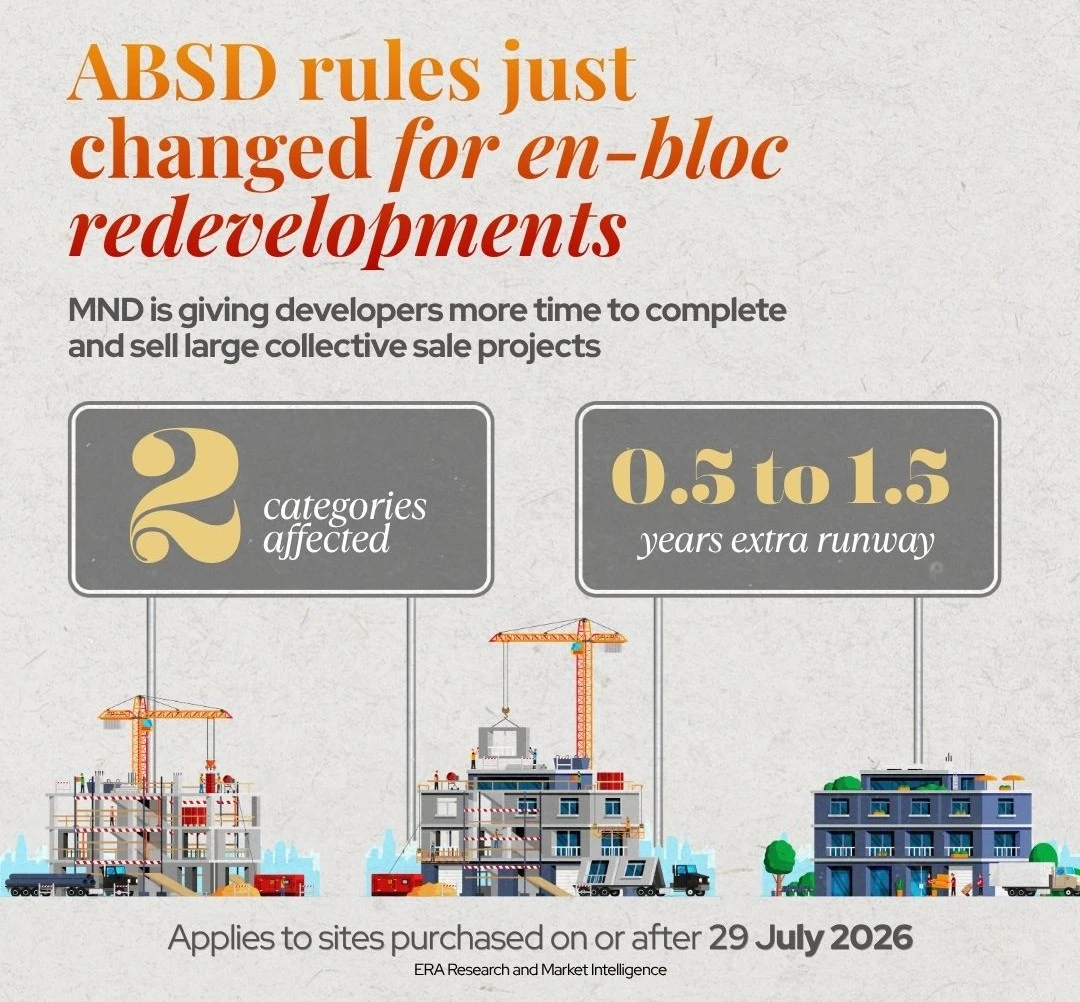
A deadline moved, and only for developers. The Ministry of National Development gave two kinds of large collective-sale site more time to finish building and sell every unit, on land bought from 29 July 2026. Sites of 700 to 1,399 homes now get six years. Sites of 1,400 homes or more get seven, if half the units are sold by the end of year six. The 40 per cent tax rate did not change.
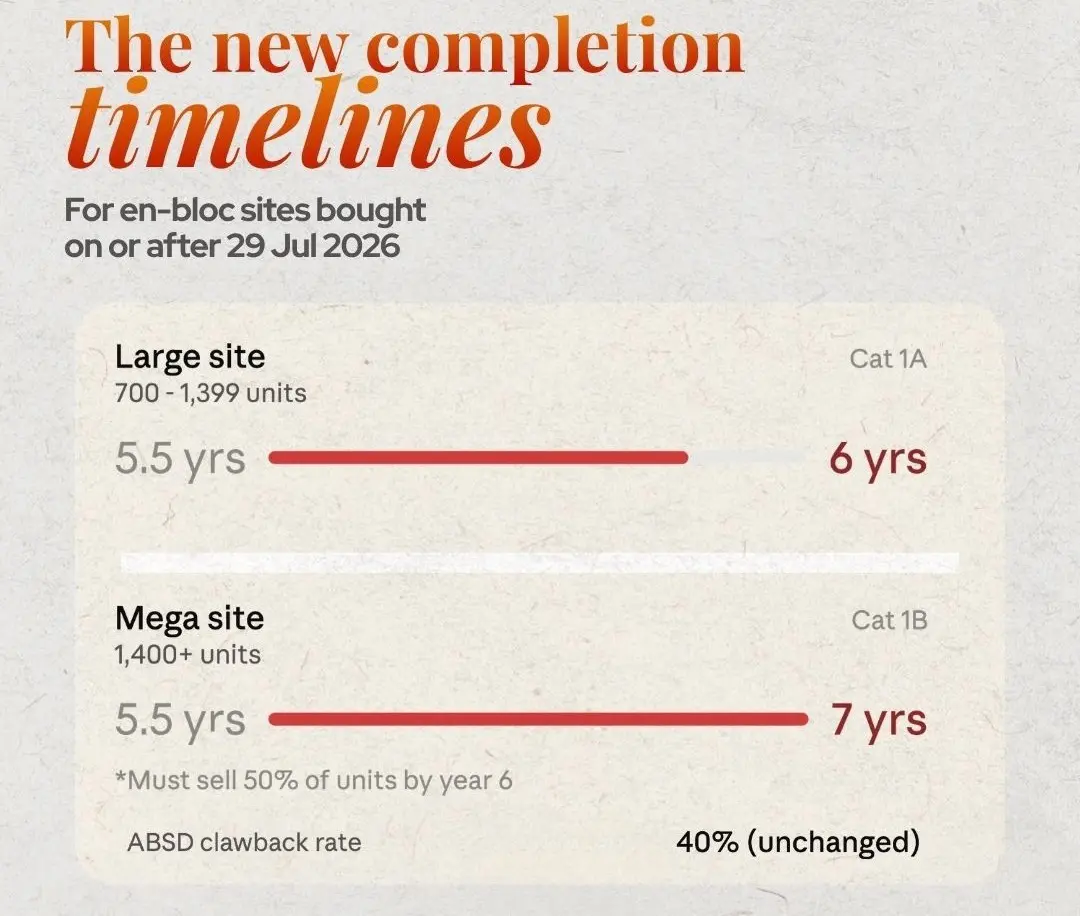
That is the whole announcement. No new tax. No new rate. Nothing changes for anyone buying a home. What moved is a deadline that only licensed housing developers face, and it moved for one specific kind of site. It is still worth explaining properly, because that deadline is the single biggest reason Singapore's collective sale market has been quiet since 2018.
How does the ABSD clock work for a developer?
Most coverage skips this part. Without it, the change makes no sense.
When a licensed developer buys residential land here, it pays ABSD of 40 per cent of the price. That splits in two. A 5 per cent slice is never refunded, so the developer simply builds it into the deal. The other 35 per cent is paid upfront and refunded later. But it is only refunded if the developer finishes the project and sells every single home inside a fixed window. Miss the window and the 35 per cent is taken back, with interest.
The standard window is five years from the day the land was bought. Since 6 March 2025, four kinds of harder project have qualified for extra time. One of them is large collective-sale redevelopment, meaning sites that yield at least 700 homes and at least 1.5 times what the old development held. Those sites got an extra six months, which is where the 5.5-year figure comes from. The Inland Revenue Authority of Singapore administers the refund.
So the 35 per cent is not really a tax. It is a bet on the calendar. And on a very large site, five and a half years is tight. The developer must get planning approval, move the existing residents out, demolish a whole condominium, build 1,400 homes, and then find 1,400 buyers. All before the clock runs out. One bad quarter of sales near the end can put a nine-figure sum at risk.
How does the old timeline compare with the new one?
The change is easiest to see side by side.
| Site size | Before 29 Jul 2026 | From 29 Jul 2026 | Extra runway | Conditions |
|---|---|---|---|---|
| Large site, 700–1,399 units (Cat 1A) | 5.5 years | 6 years | +6 months | Complete and sell all units |
| Mega site, 1,400+ units (Cat 1B) | 5.5 years | 7 years | +18 months | At least 50% of units sold by end of year 6 |
| ABSD clawback rate | 40% (5% + 35%) | 40% (5% + 35%) | No change | 5% non-remittable, 35% remittable |
Eighteen months on a mega site is not a rounding error. Take an illustrative project of 1,400 homes at an average of $2 million each (est.). An extra eighteen months gives the developer six more quarters to sell roughly $2.8 billion of stock (est.). It can do that without cutting prices at the end just to beat a deadline. That is the practical value of this change, and it is why the biggest category got three times the extension the merely large one did.
The halfway checkpoint is the part we find most interesting. The government gave ground on the total timeline, then built in a test partway through. Sell half your units by year six and you keep the seventh year. Our reading is that MND wants to take the risk out of building and selling huge projects, without handing developers a reason to trickle units into the market slowly.
Why did the government move now?
Because collective sales have started to stir again, and the old deadline was about to become the thing that stopped them.
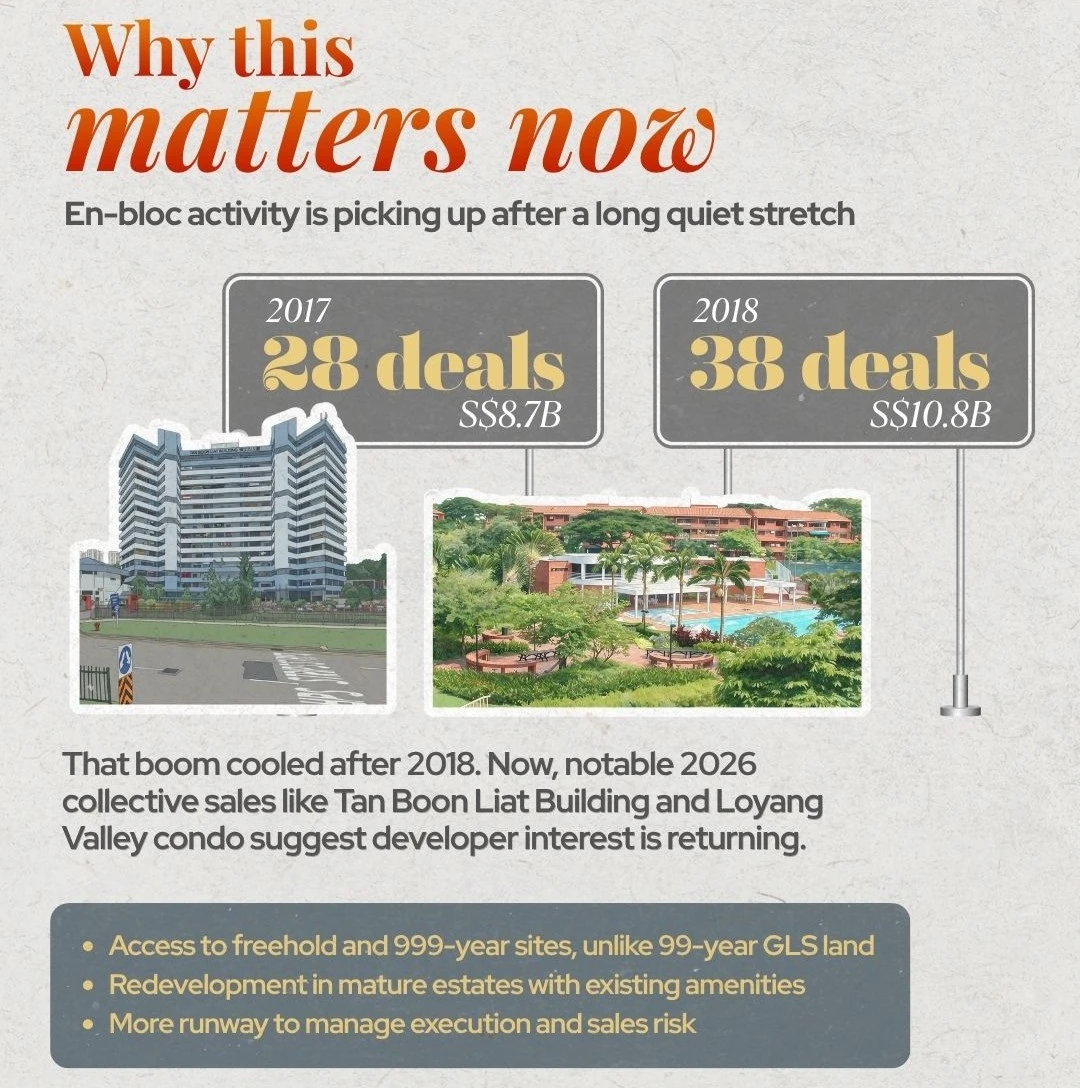
Singapore's last collective sale cycle peaked before the pandemic. There were 28 deals worth a combined S$8.7 billion in 2017, then 38 deals worth S$10.8 billion in 2018, on ERA Research and Market Intelligence figures. Then the July 2018 cooling measures landed, developer ABSD went up, and the market went quiet for the best part of eight years.
2026 has brought the first real signs of life. Tan Boon Liat Building and Loyang Valley condominium both sold collectively. Marcus Chu, chief executive of ERA Singapore, called the revisions welcome and said the added flexibility could help sustain the recent pick-up. Read alongside the timing, this looks less like a stimulus and more like the government clearing one specific obstacle it could see forming.
There is a supply argument underneath it too. State land through the Government Land Sales programme is finite, and the well-located plots draw crowded tenders. We have watched that intensity in our land cost tracker and in the 1H 2026 GLS review. Collective sales widen the pool in two ways. They reach established neighbourhoods where no undeveloped state land is left. And they are the only route to freehold or 999-year tenure, because state residential plots are all sold on 99-year leases.
What does it mean if you own a unit in an older estate?
It slightly improves your odds of ever seeing a collective sale succeed. Not because your neighbours will agree any faster. Because the sums on the buyer's side got a little easier.
A developer looking at a big site runs a risk model before it bids. How long to get approvals. How long to build. How fast the units will clear. And what happens if the market softens in year four. Adding twelve to eighteen months of tolerance to that model makes some marginal sites worth bidding for that previously were not. Chu made the same point, saying the revisions may improve the case for redeveloping selected large ageing estates.
What this does not do is change price. A collective sale still fails if owners want more than the land is worth to a developer, once you subtract building costs, financing, demolition, any lease top-up and land betterment charges. Far more collective sales die on that gap than on any deadline.
What does it mean if you are buying a home?
In the near term, nothing at all. Your own stamp duty is unaffected, and you can check it with our stamp duty calculator. No unit reaches a showflat because of this announcement for at least three or four years, because the sites in question have not even been bought yet.
The interesting part is what it does to the shape of the pipeline later this decade. Two things follow if the collective sale market really does reopen.
- More freehold and 999-year launches. Nearly everything in the current pipeline is on a 99-year lease, because that is what the state sells. Collective sale sites are the main source of anything else. Tenure has a measurable effect on long-run outcomes, which you can check in our price trends dashboard.
- New homes in estates that have run out of land. Rebuild in an older area and the schools, MRT lines and shops are already there. That is a different proposition from a new estate built from scratch.
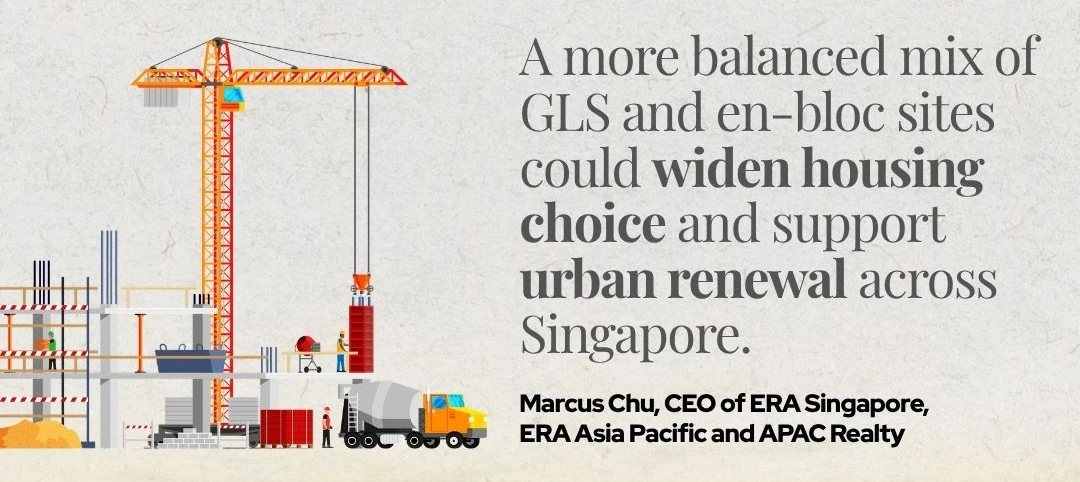
We would put it more cautiously than that. A wider mix of land sources is good for buyers, but the effect will be small and slow. Even a strong collective sale year adds only a handful of sites, against a state programme that supplies the bulk of new private housing. And the first completions from anything bought under these new rules land somewhere around 2032.
What is the case against getting excited?
Three reasons to keep expectations modest.
First, deadlines were never the real problem. Collective sales fail on price. Owners anchor on the last boom. Developers price off today's building costs and their own view of what the finished homes will sell for. The two numbers do not meet. Chu said as much, noting that a broad revival still depends on owners and developers agreeing on land costs, building costs, financing and achievable selling prices. An extra year of runway does not close a 20 per cent price gap.
Second, only very large sites qualify. The categories start at 700 units. Most collective sale candidates in Singapore are far smaller and get nothing from this. It is aimed at a handful of very big ageing estates. That is a deliberate choice rather than a flaw, but it does cap how much the change can move the market.
Third, state land still wins on certainty. A state tender has a known site, a known lease and a known density, with nobody to negotiate with. A collective sale needs a set share of owners to agree. It can also face objections at the Strata Titles Board, demolition costs, and much longer lead times. ERA expects collective sales to stay a complement to state land rather than a replacement, and we agree.
What do we expect, and what would prove us wrong?
Our view, stated so it can be checked later.
- More collective sale attempts within twelve months, concentrated in developments of 400 or more existing units. That is where the 700-unit redevelopment threshold is reachable. If new attempts cluster in small developments instead, this change is not what is driving them.
- Successful deals stay in single digits a year through 2027. Trying is cheap. Agreeing is not. A double-digit year would mean price expectations converged faster than we think.
- Asking prices rise before deals do. Owners read any easing of the rules as a reason to ask for more. That usually delays the first wave of successful sales rather than speeding it up.
- No measurable effect on 2026 or 2027 launch supply. Nothing bought under these rules can be finished before roughly 2032. If launch volumes move this year, the cause is the state land pipeline, not this announcement. Our monthly developer sales analysis is where any surprise would show up first.
Want to go deeper? Our pricing methodology shows how land cost feeds into what buyers eventually pay, and the land cost tracker holds the ten-year record. For timing, our standing view is in buy, wait or upgrade. On the public housing side, see our analysis of the removal of the 15-month wait-out period. And for how buying an unbuilt project works, start with our guide to buying a new launch condo, or compare two projects in the comparison tool.
The short version — read this first
Six things to take away.
What we found
- What actually changedA deadline, not a tax. Big collective-sale sites get 6 or 7 years instead of 5.5 to finish building and sell out
- Who it affectsLicensed housing developers only. Nothing changes for people buying a home
- The rate did not moveStill 40%: a 5% slice the developer never gets back, and a 35% slice refunded only if it beats the deadline
- Why nowCollective sales stirred again in 2026 after eight quiet years. The old deadline was about to block them
- Only very big sites qualifyThe threshold starts at 700 units. Most collective-sale candidates are far smaller and get nothing
- Deadlines were never the real problemDeals fail on price. An extra year does not close a 20% gap between what owners want and what developers will pay
So what should you do with this?
- If you own in an older estate of 400 units or more, expect more collective-sale approaches. Expect most of them to fail on price anyway.
- If you are buying a home this year, ignore this. Your own stamp duty is unchanged and no new units appear before about 2032.
- If freehold matters to you, watch this space later in the decade. Collective sales are the main source of anything that is not a 99-year lease.
Key takeaways
- Who it affectsLicensed housing developers buying en bloc sites
- Sites yielding 700–1,399 units (Cat 1A)6 years to complete and sell
- Sites yielding 1,400+ units (Cat 1B)7 years, 50% sold by year 6
- Previous timeline for these sites5.5 years
- ABSD clawback rate40%, unchanged
- Government Land Sales sitesNot covered by this change
- Effect on home buyers todayNone directly
Five terms used in this article
- ABSDAdditional Buyer's Stamp Duty. An extra tax on second and later homes, on foreign buyers, and on developers buying land
- RemissionA refund of tax already paid, given only if certain conditions are met
- Collective sale (en bloc)Where the owners of an older development agree to sell the whole site together to a developer
- GLSGovernment Land Sales. The programme through which the state sells land to developers by tender
- Leasehold and freeholdA 99-year lease runs out and returns to the state. Freehold and 999-year tenure effectively do not
Frequently asked questions
What changed in the ABSD rules for developers on 29 July 2026?
The Ministry of National Development gave two kinds of large collective-sale site more time. Sites yielding 700 to 1,399 homes now get six years to finish the project and sell every unit. Sites yielding 1,400 or more get seven years, as long as at least half the units are sold by the end of year six. It applies to sites bought on or after 29 July 2026.
How much extra time do developers actually get?
Between six and eighteen months. Large collective-sale sites already had a six-month extension on the standard five-year deadline, under rules in force from 6 March 2025. That gave them 5.5 years. The new framework moves that to six years for sites of 700 to 1,399 homes, and seven years for sites of 1,400 or more.
Did the ABSD rate for developers change?
No. It stays at 40 per cent. That is a 5 per cent slice paid upfront and never refunded, plus a 35 per cent slice refunded only if the developer beats the deadline. Only the deadline moved. The announcement changed timelines, not tax rates.
Does this apply to Government Land Sales sites?
No. The new timelines apply to collective-sale sites, which developers buy from existing owners. Government Land Sales sites are state land sold by tender, and they are not covered. ERA expects state land to remain developers' main source of residential land.
Will this restart the en bloc market in Singapore?
It removes one obstacle, not all of them. The last boom ran in 2017 and 2018, with 28 deals worth S$8.7 billion and then 38 deals worth S$10.8 billion, on ERA figures. A recovery still depends on owners and developers agreeing on price, alongside building costs, financing, demolition costs, lease top-ups and land betterment charges. We expect any pick-up to be selective.
What does the ABSD change mean for buyers of new condos?
Very little in 2026, and something worth watching after that. Nothing here changes the stamp duty an individual buyer pays, and no new units reach the market for years. The longer-term effect is more choice. Collective sale sites are often freehold or 999-year and sit in established estates, so a healthier market adds tenure options that the 99-year state programme does not offer.
Why is there a 50 per cent sales condition on the seven-year timeline?
It stops the longest timeline from becoming a reason to hold units back. Developers of projects with 1,400 homes or more must sell at least half of them by the end of year six to keep the seventh year. We read it as the government giving flexibility on building and selling, while keeping pressure on developers to release stock.
Sources & methodology
The policy facts in this article, meaning the two affected categories, the six-year and seven-year timelines, the 50 per cent intermediate sales condition, the 29 July 2026 application date and the unchanged 40 per cent clawback comprising a 5 per cent non-remittable and a 35 per cent remittable component, are as announced by the Ministry of National Development and set out in ERA Singapore's commentary of 28 July 2026. The quoted comments from Marcus Chu, CEO of ERA Singapore, ERA Asia Pacific and APAC Realty, and the 2017 and 2018 collective sale figures of 28 deals worth S$8.7 billion and 38 deals worth S$10.8 billion are from the same publication, compiled by ERA Research and Market Intelligence. The four graphics on this page are reproduced from that commentary.
The 5.5-year baseline is our own reconstruction rather than a figure in the announcement: it combines the standard five-year ABSD remission timeline for licensed housing developers with the six-month extension for Category 1 en bloc redevelopments, meaning sites yielding at least 700 units and at least 1.5 times the number of homes in the existing development, which took effect on 6 March 2025. That framework is published by MND and administered by the Inland Revenue Authority of Singapore. Whether the pre-existing 1.5-times multiple and the other extension categories carry over unchanged into the revised framework was not spelled out in the material available on publication day; developers and owners should confirm the operative conditions with IRAS and MND before relying on them. We will update this page when the full implementation details are published.
Disclaimer. This article is independent research published for general information and education. It is not financial, investment, legal, tax or property advice and does not consider your circumstances. PropertyInsider.sg does not adjudicate ABSD remission eligibility; that sits with IRAS and MND, and developers should take their own professional advice. The expectations set out above are the publication's own view, deliberately falsifiable, and may prove wrong. Figures are compiled in good faith from sources believed reliable as at 29 July 2026 but are not guaranteed. Verify against MND, IRAS and URA publications before making decisions. Our practices are set out in our editorial policy.
Update history
- Article published on the day the revised ABSD remission timelines took effect, covering the two affected en bloc categories, the reconstructed 5.5-year baseline, the 50 per cent year-six sales condition and the market context from ERA Research and Market Intelligence. Next scheduled update: when MND and IRAS publish the full implementation conditions, and again on the first qualifying collective sale transacted under the new framework.