
What changed on 28 July 2026?
Private property owners can now buy a non-subsidised HDB resale flat straight away. The 15-month wait is gone, with immediate effect, as long as they do not take an HDB housing loan. One duty replaces it. The private property, here or overseas, must be sold within six months of completing the flat purchase. The 30-month wait for subsidised flats and for an EC bought from a developer is unchanged.

Our reading matches the industry's. This is a recalibration, not a loosening of the housing system. The measure came in during September 2022, as a temporary brake while resale prices were rising sharply. Prices have since flattened and fallen. And a much larger wave of flats is about to reach the resale market. So the brake came off because the conditions that justified it are gone. Every rule that protects subsidised housing stays in place.
Who does this apply to, and who still waits?
The most common misreading this week will be that private owners can now buy any flat without waiting. They cannot. The change is narrow, and the table below is the whole of it.

| What you want to buy | Waiting period | Other conditions |
|---|---|---|
| Resale flat, no grants, no HDB loan | None — buy now | Sell private within 6 months of completion |
| Resale flat with housing grants | 30 months after selling private | Unchanged |
| New BTO flat from HDB | 30 months after selling private | Unchanged, with or without grants |
| Executive condominium from a developer | 30 months after selling private | Unchanged |
| Any flat financed with an HDB housing loan | 30 months after selling private | Bank financing required to use the new route |
Two practical points sit underneath it. First, private owners and former owners must get an HDB Flat Eligibility letter, exactly as first-time resale buyers do. The letter is what confirms you qualify. The news does not. Second, the six-month deadline covers every private home you own, here or abroad. The clock starts when the flat purchase completes, not when you sign the option. Separately, HDB had been handling roughly 1,800 appeals for a waiver each year, and granting about one in four. Anyone still waiting on an appeal can now apply for the letter directly.
Why did the government move now?
Two things changed, and the announcement rests on both. Neither has anything to do with private property.
Reason 1: HDB resale prices had already cooled
The HDB Resale Price Index fell 0.1 per cent in the first quarter of 2026 and 0.3 per cent in the second. Those were the first back-to-back falls in years. They followed five straight quarters of slower or no growth, stretching back to late 2024. So a measure introduced to slow a fast market had, on the government's own indicator, finished its job.

Reason 2: a much bigger wave of flats is about to become sellable
This is the part that makes the change workable, and the part most coverage will skip. The number of flats reaching the five-year mark, when they can be sold on the resale market, is about to rise steeply. Supply was unusually thin in 2024 and 2025, because building work on new flats stalled during the pandemic. From 2026 the completions catch up.
By 2028, roughly 21,393 flats reach that mark, against 6,973 in 2025. That is more than three times the low point, and well above the five-year average of 14,547. This pipeline is why the wait-out could go without the resale market tightening again. Extra demand from private owners arrives alongside a much larger pool of flats for sale. Eugene Lim of ERA Singapore called it a measured response to a more balanced resale market. That is the fairest one-line summary of it. The caveat is timing rather than direction. Becoming eligible to sell is not the same as listing, so the supply arrives with a lag while the demand arrives at once.
What detail will most coverage bury?
Put the old rule and the new one side by side and the change is not really about waiting. It is about the order you do things in.
| Stage | Before 28 Jul 2026 | From 28 Jul 2026 |
|---|---|---|
| Order of transactions | Sell private, then buy flat | Either order; buy first is permitted |
| Gap between the two | At least 15 months | None required |
| Interim housing needed | Yes, typically a 15-month rental | Usually none |
| Deadline on the private sale | None; owner sets the timetable | 6 months from flat completion, if buying first |
| Subsidised flat or EC from developer | 30-month wait | 30-month wait, unchanged |
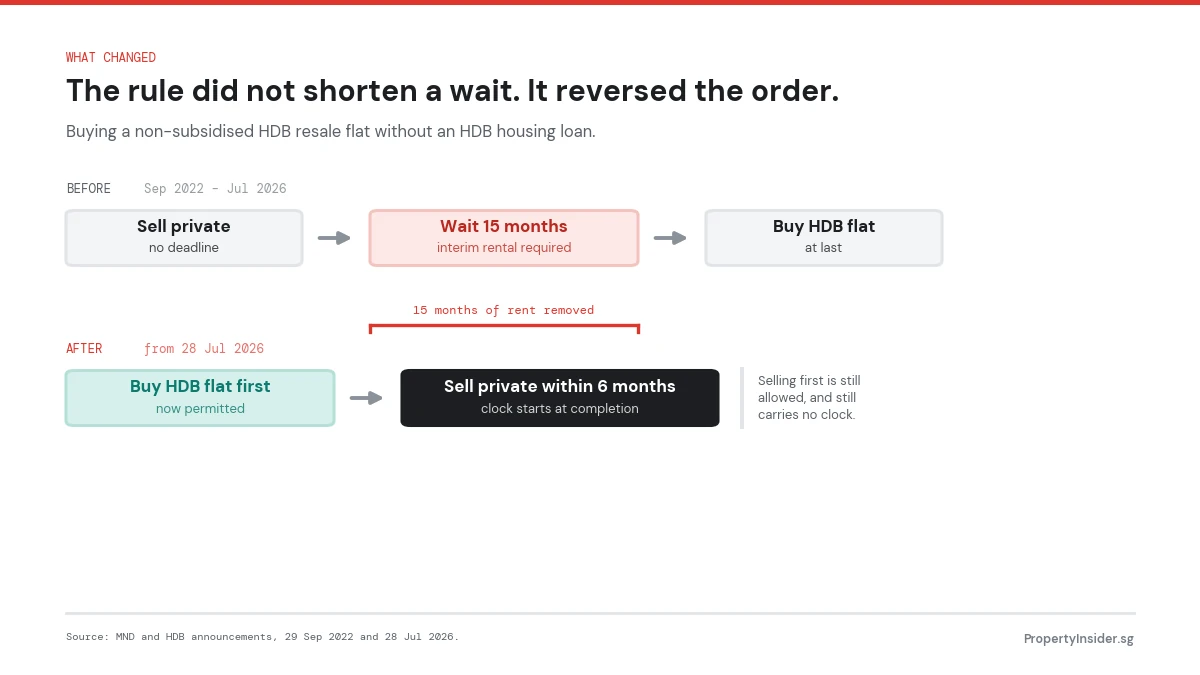
Selling first carries no clock at all, and for most households that remains the safer route. But an owner who buys the flat first gains something new: a deadline. Six months from completion, with a purchase already committed. That is a very different position to negotiate from than an open-ended listing. And it is the mechanism through which a public housing rule reaches private asking prices.
Who actually moves out of a private home?
The debate treats people moving down the ladder as one group. Our data says they are quite specific. We looked at 32,414 profitable matched sales from 199 condo projects. They ran from January 2018 to April 2026. Of those, 10,558, or 32.6 per cent, came from owners who had held for ten years or more. That is the group with enough equity for a downgrade to be worth doing.
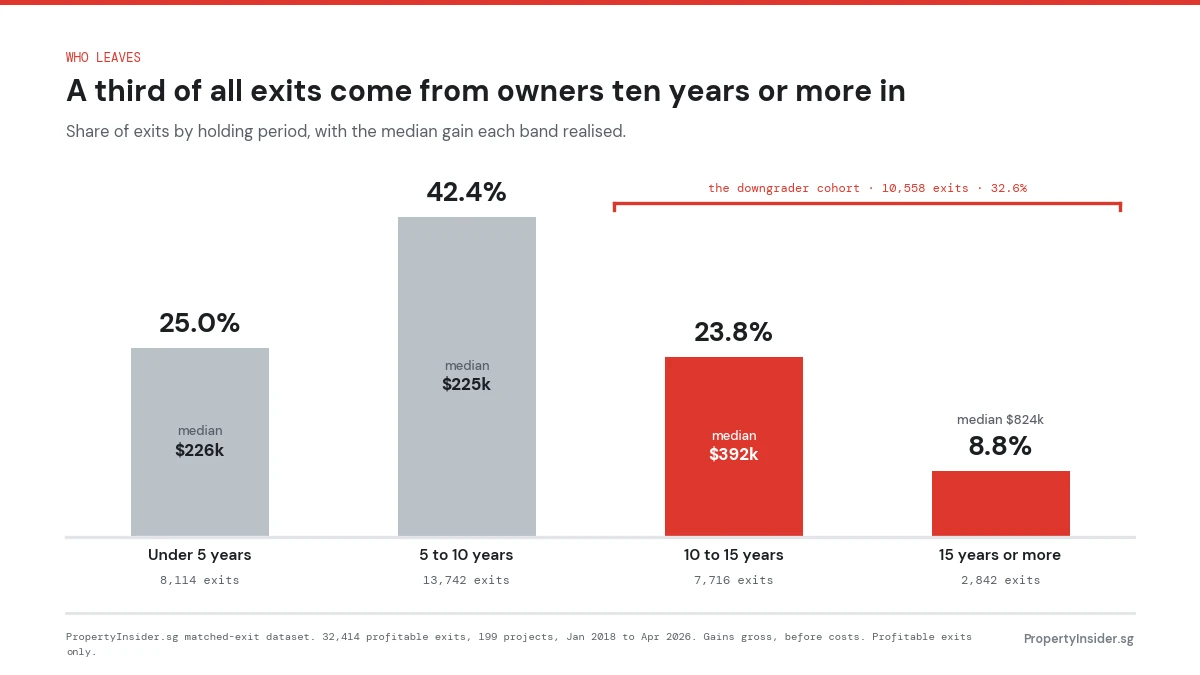
| Holding period | Exits | Share | Median gain | Median gain % | Median annualised |
|---|---|---|---|---|---|
| Under 5 years | 8,114 | 25.0% | $226k | 19.6% | 4.99% |
| 5 to 10 years | 13,742 | 42.4% | $225k | 21.7% | 3.01% |
| 10 to 15 years | 7,716 | 23.8% | $392k | 37.0% | 3.06% |
| 15 years or more | 2,842 | 8.8% | $824k | 105.0% | 4.52% |
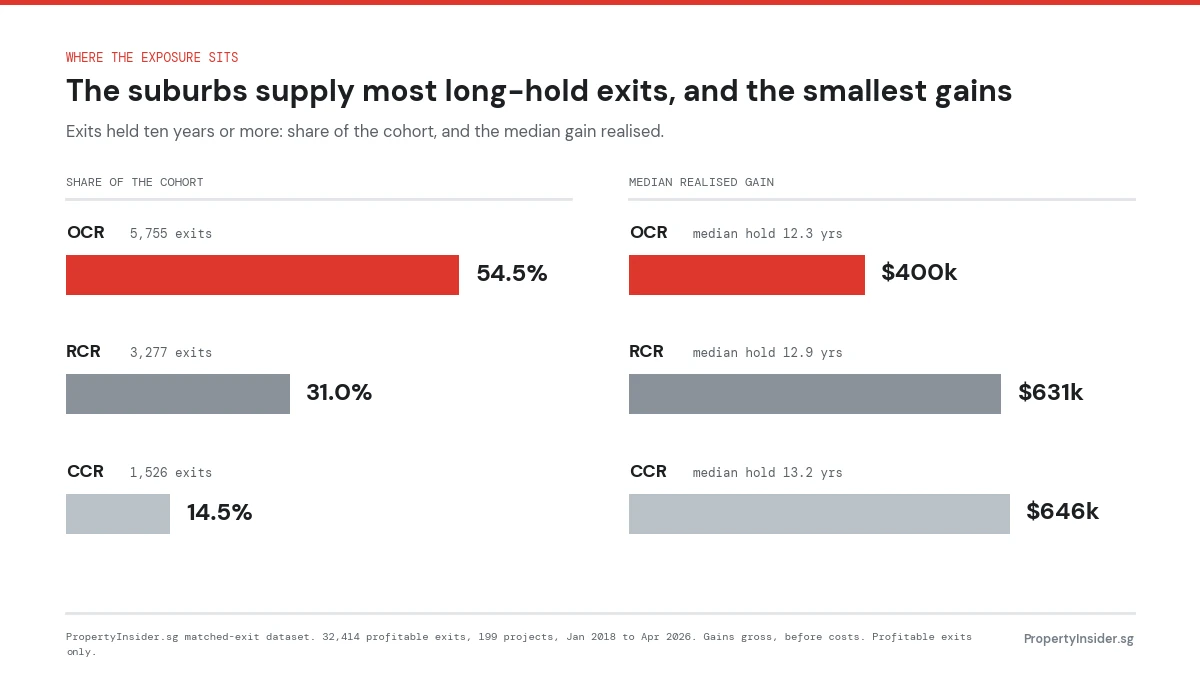
Where that group lives is the useful part. Of those 10,558 long-hold sales, 5,755, or 54.5 per cent, were in the OCR. Another 3,277 were in the RCR and 1,526 in the CCR. The median size was about 1,054 sq ft. So this is not a prime-market story.
Which owners have the least to fall back on?
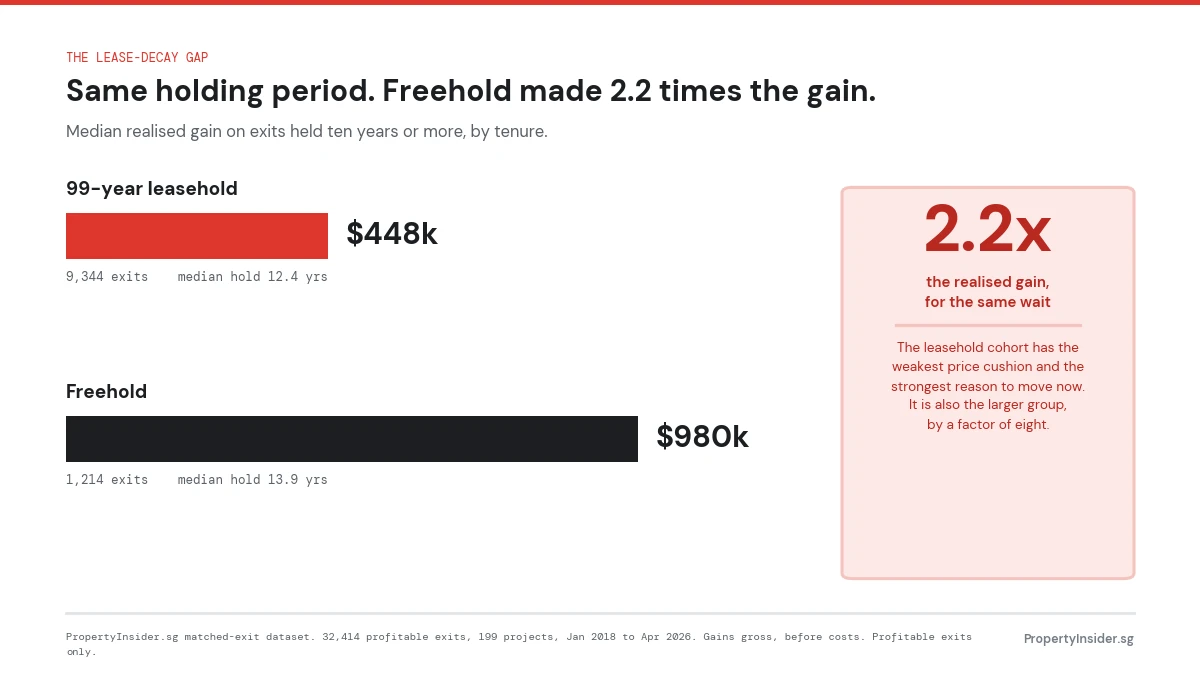
The owners of older leasehold homes. Split those long-hold sales by tenure and the gap is stark. Sales from 99-year leasehold projects held ten years or more returned a median gain of $448,000 across 9,344 records. Freehold sales held the same time returned $980,000 across 1,214 records. That is 2.2 times the gain for the same waiting time.
Now narrow it further, to older leasehold homes in the OCR. Take OCR projects finished in 2010 or earlier, on 99-year leases, held at least ten years. That is 2,317 sales, with a median hold of 15.2 years and a median gain of $487,000, or 65.4 per cent. That is decent money. But the gain arrives mostly through the passage of time, while the lease runs down. These are the households for whom swapping a decaying leasehold condo for a flat plus cash makes the most sense on paper. They are also the ones most put off by 15 months in rented accommodation. So that is the profile this change frees. A 99-year unit of roughly 1,000 to 1,200 sq ft in the OCR or in the RCR, finished before about 2012, with an owner 12 to 15 years in. Project-level history sits in our price trends dashboard.
What do we think happens next?
Our view, stated so you can check it against reality later. The change works largely as intended. The headline private price index barely moves. And the visible action sits in the HDB resale market rather than the private one.
The arithmetic supports that. Even on generous assumptions, the group that was put off numbers in the low thousands of households a year. The private resale market transacts in the tens of thousands. That is not enough to bend a national index. On the HDB side, the incoming demand meets a pipeline that roughly triples between 2025 and 2028. Which is precisely why the measure could be removed at all.
Here are the specific expectations, each with the thing that would prove it wrong.
- HDB resale transactions hold around 26,000 to 27,000 in 2026, the range ERA kept after the announcement. Materially more than that would mean the waiting group was larger than the appeal numbers suggest.
- The freed-up demand goes into larger, newer and better-located flats, rather than lifting the whole index evenly. That is what someone with private sale proceeds buys. If the cheapest flats move first instead, the group is under more financial pressure than we think.
- Private resale volumes in ageing OCR and RCR leasehold rise before prices react, because the six-month clock forces completion. Flat caveat counts in that segment through the last quarter of 2026 would mean the effect is negligible.
- The spread inside the private market widens a little. The price gap between pre-2012 leasehold and newer comparable homes should stretch. If it narrows instead, we are over-weighting these sellers.
- Mass-market rental demand softens slightly over two to three quarters, as the group renting between homes stops forming. Firm OCR rents through the first quarter of 2027 would prove that wrong.
- New launch demand barely changes. People leaving private housing for a flat are not new launch buyers. And the 30-month wall still stands between private owners and an EC bought from a developer. Our monthly developer sales analysis is where this would show up first if we are wrong.
The change should also do something harder to measure. It should make movement along the housing ladder smoother in both directions. Households who could not face 15 months of rental limbo can now move to a smaller home. And each of those moves releases a private resale unit for someone else. The trade-off is coordination. The eligibility letter, the financing, the sale proceeds and two completion dates all have to line up.
What could we have wrong?
Four honest limits.
Our data only covers sales that made money. Every gain figure comes from a transaction that made money. So the medians look better than the typical owner's outcome. The 2.2-times freehold-to-leasehold gap compares two profitable groups, not two complete ones, across 199 tracked projects to April 2026.
The effect could run the other way. Removing a cooling measure is widely read as a signal that the tightening cycle has turned. And the buy-first option lets owners avoid the forced sale that a 15-month clock used to require. That argues for fewer distressed listings, not more. If mood wins out, private prices hold up rather than fall.
Supply arrives on a lag. Becoming eligible to sell is not the same as listing. And the 2027 and 2028 waves do nothing for a resale market absorbing extra demand in late 2026. If demand comes early and supply does not, the HDB resale index could firm before the pipeline catches up. That would reopen the policy question rather than settle it.
Timing is not totals. Households who move down because the friction disappeared were mostly going to move down eventually. This pulls those transactions forward into fewer quarters. And pulled-forward supply looks like a wave on the way in and a lull on the way out.
What does it mean for you?
If you own private property and are considering a flat: the choice of order is now yours, and it is a real one. Selling first keeps your bargaining power and gives you certainty on the proceeds. Buying first solves the where-do-we-live problem, but starts a six-month clock in a segment that may not sell quickly. Get that letter early. Run both routes through our affordability calculator. Then check what Seller's Stamp Duty you would owe, using our stamp duty calculator. And note the condition inside the rule itself: no HDB housing loan.
If you own ageing leasehold in the OCR or RCR: you are the segment most affected, on both sides. More of your neighbours can now sell. The pool of buyers for your unit is unchanged. That makes the next few quarters worth watching. Pricing history is in price trends.
If you own an HDB flat and plan to upgrade: almost nothing here applies to you. That is worth saying plainly, because the headline invites the opposite conclusion. The mechanics are unchanged, and we work through them in our sell HDB, buy new launch guide.
If you are weighing a second home against moving to a smaller one: our decoupling guide and decoupling calculator show how to change who owns what. The TDSR guide covers the borrowing limits that usually decide which options are open at all. Our standing view on the cycle is in buy, wait or upgrade and the new shape of Singapore housing demand.
If you are tracking supply: the other policy move of the same week sits on the land side, where revised deadlines gave developers more time on large collective-sale sites. The launch pipeline is in our GLS pipeline tracker and upcoming launches. Land costs sit in the land cost tracker. Our estimated launch prices come from the model at pricing methodology, and you can compare any two projects in the comparison tool.
The short version — read this first
Seven things to take away.
What we found
- What changedPrivate owners can buy a non-subsidised resale flat straight away, with no HDB loan. No more 15-month wait
- What replaced itSell the private property within six months of completing the flat purchase
- What did not changeThe 30-month wait still applies to subsidised flats, grants, an EC from a developer, and any HDB loan
- Why now, reason oneThe HDB resale index fell 0.1% then 0.3%, its first back-to-back falls in years
- Why now, reason twoFlats reaching the five-year mark rise from 6,973 in 2025 to about 21,393 in 2028
- Who is really affectedOwners of ageing OCR 99-year condos. Their median gain was $448,000, against $980,000 for freehold
- Our expectationThe headline private price index barely moves. The visible action is in the HDB resale market
So what should you do with this?
- If you own private property and want a flat, apply for the HFE letter early. That letter, not the news, confirms what you may buy.
- Weigh up both routes honestly. Selling first keeps your bargaining power. Buying first starts a six-month clock.
- If you already own an HDB flat and plan to upgrade, almost none of this applies to you.
Key takeaways
- Wait-out for non-subsidised resale flatsRemoved, immediate effect
- Replaced bySell private within 6 months of completion
- Subsidised flats, grants, EC from developer, HDB loan30-month wait still applies
- Why now, reason 1HDB RPI −0.1% Q1, −0.3% Q2 2026
- Why now, reason 2MOP flats rise to 21,393 by 2028
- Our view on private pricesSmall effect on the index, wider dispersion
Six terms used in this article
- Wait-out periodThe time a private property owner had to wait, after selling, before buying an HDB resale flat
- Non-subsidised resale flatA flat bought on the open market with no housing grant from HDB
- MOPMinimum Occupation Period. The five years you must live in a flat before you may sell it
- HFE letterHDB Flat Eligibility letter. HDB's written confirmation of what you may buy, what grants apply and what you may borrow
- Leasehold and freeholdA 99-year lease runs down and eventually returns to the state. Freehold does not
- OCR / RCR / CCROutside Central Region (the mass-market estates furthest from the city), Rest of Central Region (the city-fringe ring) and Core Central Region (the prime districts, such as Orchard and the CBD). URA uses these three segments
Frequently asked questions
Has the 15-month wait-out period been removed?
Yes. Minister Chee Hong Tat announced the removal on 28 July 2026. It took effect at once. It applies to private property owners and former owners buying a non-subsidised HDB resale flat without an HDB housing loan. The measure had been in place since September 2022.
Do I still need to sell my private property to buy an HDB resale flat?
Yes, but the order has changed. You must now sell your private property, here or overseas, within six months of completing the flat purchase. Previously the private property had to be sold first, followed by a 15-month wait. Buying the flat first and selling afterwards is now allowed.
Does the 30-month wait-out period still apply?
Yes. It still applies in four cases. If you are buying a subsidised flat, meaning a BTO flat or a resale flat with grants. If you are buying an EC from a developer. Or if you are using an HDB housing loan. Only the 15-month wait for non-subsidised resale flats bought without an HDB loan was removed.
Do I need an HFE letter to buy an HDB resale flat as a private property owner?
Yes. Private property owners and former owners must first get an HDB Flat Eligibility letter, the same as first-time resale buyers do. The letter confirms whether you may buy, which grants apply, and what you may borrow. Apply for it before committing to a flat. Only HDB can tell you if you qualify.
Why was the 15-month wait-out period removed in July 2026?
MND gave two reasons. First, prices had cooled. The HDB Resale Price Index fell 0.1 per cent in the first quarter of 2026 and 0.3 per cent in the second, after five straight quarters of slower or no growth. Second, supply. Many more flats are due to pass the five-year mark and reach the resale market over the next few years.
Will there be enough HDB flats to absorb the extra demand?
The pipeline suggests so, with a lag. The number of flats passing the five-year mark rises from 6,973 in 2025 to 13,480 in 2026, then 18,939 in 2027 and about 21,393 in 2028. The five-year average is 14,547. Those figures were compiled by ERA Research and Market Intelligence from HDB and Data.gov.sg data. The caveat is that becoming eligible to sell is not the same as listing. So the extra supply arrives more slowly than the extra demand.
Will removing the wait-out period cause private property prices to fall?
Our view is that the headline index moves little, within normal quarterly noise, while the spread underneath it widens. The exposed segment is ageing 99-year leasehold in the OCR and RCR, held 12 to 15 years. In our dataset of 32,414 profitable sales, 99-year leasehold homes held ten years or more returned a median gain of $448,000. Freehold homes held the same time returned $980,000. So that group has the thinnest cushion and the strongest reason to move now.
Should private property owners rush to sell now?
Not on this announcement alone. The removal changes the order and the timing, not the total number of households who will eventually move down. Owners who buy a flat first take on a six-month deadline to sell, which is a weaker position to negotiate from. Model the six-month sale window, your Seller's Stamp Duty position and the cash you need, before committing to a flat purchase.
Sources & methodology
Policy facts in this article — the immediate-effect removal, the six-month disposal requirement, the retained 30-month wait-out, the HFE letter requirement, the treatment of pending appeals, the HDB Resale Price Index movements of −0.1 per cent in Q1 2026 and −0.3 per cent in Q2 2026, and the roughly 1,800 annual appeals with about one in four acceded — are as announced by the Ministry of National Development and National Development Minister Chee Hong Tat on 28 July 2026 and as reported by Channel NewsAsia the same day. The measure was introduced in the cooling package announced jointly by MND, HDB and the Monetary Authority of Singapore on 29 September 2022. MOP flat-supply figures for 2024–2028, the 26,000–27,000 HDB resale transaction forecast for 2026 and the quoted comment from Eugene Lim are from ERA Research and Market Intelligence's commentary of 28 July 2026, compiled from Data.gov.sg and HDB data. Verify eligibility questions directly with HDB, the only authority on whether a household qualifies.
All transaction statistics are computed from PropertyInsider.sg's proprietary matched-exit dataset: 32,414 profitable matched buy-to-sell pairs across 199 Singapore condominium projects, drawn from URA caveat data, covering sales from January 2018 to April 2026, compiled with ERA Research and Market Intelligence and current as of 8 July 2026. Matched exits pair a purchase caveat with a subsequent sale caveat for the same unit. Gains are gross, before commission, stamp duties, legal fees and loan interest, so net outcomes are lower. Holding period runs from purchase to sale date, not days on market. The dataset captures profitable exits only, so all medians quoted here describe owners who made money and should not be read as market-wide returns. Segment classifications (CCR, RCR, OCR) follow URA planning-area definitions. The interactive version of this dataset is published at price trends.
Disclaimer. This article is independent research published for general information and education. It is not financial, investment, legal or property advice and does not consider your circumstances. PropertyInsider.sg does not adjudicate HDB eligibility; eligibility questions go to HDB.gov.sg. The expectations above are the publication's own view, explicitly falsifiable, and may prove wrong: markets respond to interest rates, supply, employment and sentiment as well as policy. Figures are compiled in good faith from sources believed reliable as at 29 July 2026 but are not guaranteed. Verify against MND, HDB and URA publications before making decisions. Our practices are set out in our editorial policy.
Update history
- Wording pass. Region names now use URA's CCR, RCR and OCR labels in place of prime centre, city fringe and suburbs. No figures changed.
- Substantial revision. Added the eligibility matrix and HFE letter requirement, the HDB Resale Price Index chart, and the 2024–2028 MOP flat-supply pipeline (five-year average 14,547, rising to about 21,393 flats in 2028) from ERA Research and Market Intelligence. The outlook was rebalanced: the supply pipeline, not the demand release, is the load-bearing part of this change, and the article now reads it as a measured recalibration whose visible effects sit in the HDB resale market rather than the private index. Expectations restated, including ERA's 26,000–27,000 HDB resale transaction forecast for 2026, and a supply-lag limit added to the counter-case.
- Article published, within hours of the Ministry of National Development announcement of 28 July 2026. Transaction analysis computed from PropertyInsider.sg's matched-exit dataset as at 8 July 2026. Next scheduled update: on release of Q3 2026 HDB Resale Price Index flash estimates (early October 2026), when the first post-removal quarter can be measured against the expectations set out above.