
What changed for executive condominiums on 8 May 2026?
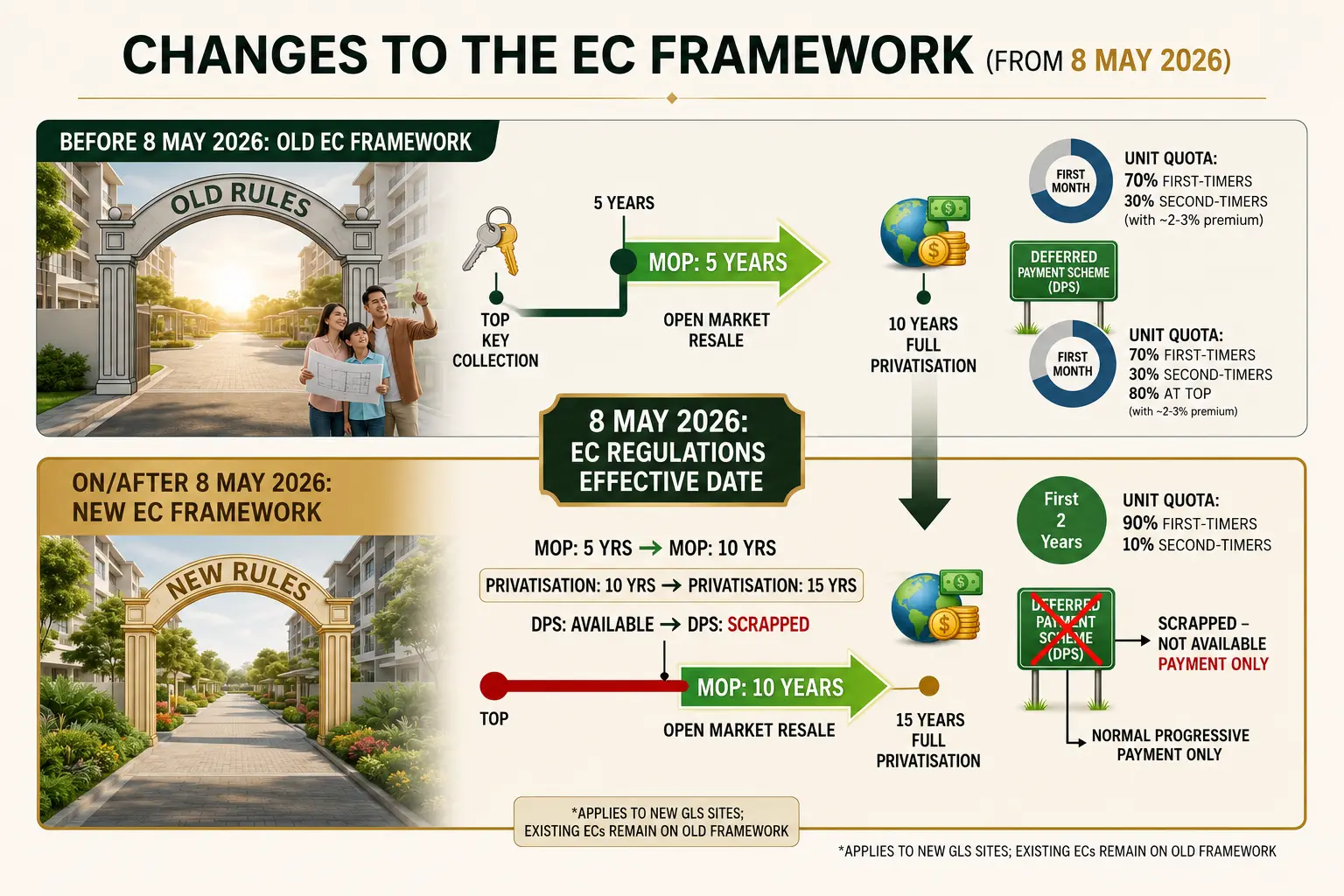
Four things, but only for EC land whose tender closes on or after 8 May 2026. You must live in the home for ten years instead of five. It becomes fully private at fifteen years instead of ten. The deferred payment scheme is withdrawn. And 90% of launch-day units go to first-timers, up from 70%, with second-timers waiting two years rather than one month for what is left.
The trigger is the land tender date. Projects on land already awarded keep every old rule, and that sentence is doing the work here. A policy that applies only to land not yet sold changes nothing about the market for three or four years. But it changes the character of everything already in the pipeline immediately. Roughly 2,000 existing or upcoming EC units sit on land bought before the cut-off. Every one of them now has a feature the next generation of ECs will not.
Key takeaways
- What triggers the new rulesEC land tender closing on/after 8 May 2026
- Minimum occupation period10 years, from 5
- Full privatisation15 years, from 10
- Deferred payment schemeWithdrawn
- Launch-day quota90% first-timers / 10% second-timers
- Second-timer priority wait2 years, from 1 month
- Unaffected pipeline~2,000 units on pre-cut-off land
- Median new EC price growth, 2021–1Q26+57%
Six terms used in this article
- ECExecutive condominium. A condo built by a private developer but sold with HDB-style rules and income limits
- MOPMinimum Occupation Period. The years you must live in the home before you may sell it
- PrivatisationThe point at which an EC becomes a fully private condo, and can be sold to foreign buyers
- Second-timerA household that has already had a subsidised flat, such as a BTO flat or a resale flat bought with a grant
- psf pprWhat a developer paid for land, per square foot of floor space it is allowed to build
- TOPTemporary Occupation Permit. The point at which the project is finished and you can move in
Why did the government move on ECs at all?
Because of what the EC had turned into. It was introduced in 1995, for households who could comfortably afford an HDB flat but could not reach a private condominium. Private developers build and sell them on land HDB tenders. Buyers get the same pools, gyms and gated entrance as a private project. In exchange there is a fence around who may buy: a Singapore citizen applicant, one of four household types, a $16,000 monthly household income ceiling, and a minimum period you must live there.
Three reasons were given for tightening it. Stability: median new EC prices rose 57 per cent between 2021 and the first quarter of 2026. Priority: second-timer households, meaning those who had already taken a subsidised flat, had grown to around 70 per cent of EC buyers, against 20 to 30 per cent four or five years earlier. Prudence: the deferred payment scheme let buyers commit to a second property while paying nothing on it for three to four years.
Read together, those three are one argument. The EC had drifted. It started as a first home for the squeezed middle. It had become a well-structured second purchase for households already on the ladder.
Why was the EC so hard to resist?
The appeal is not sentimental. It is arithmetic, and it shows up in two charts.
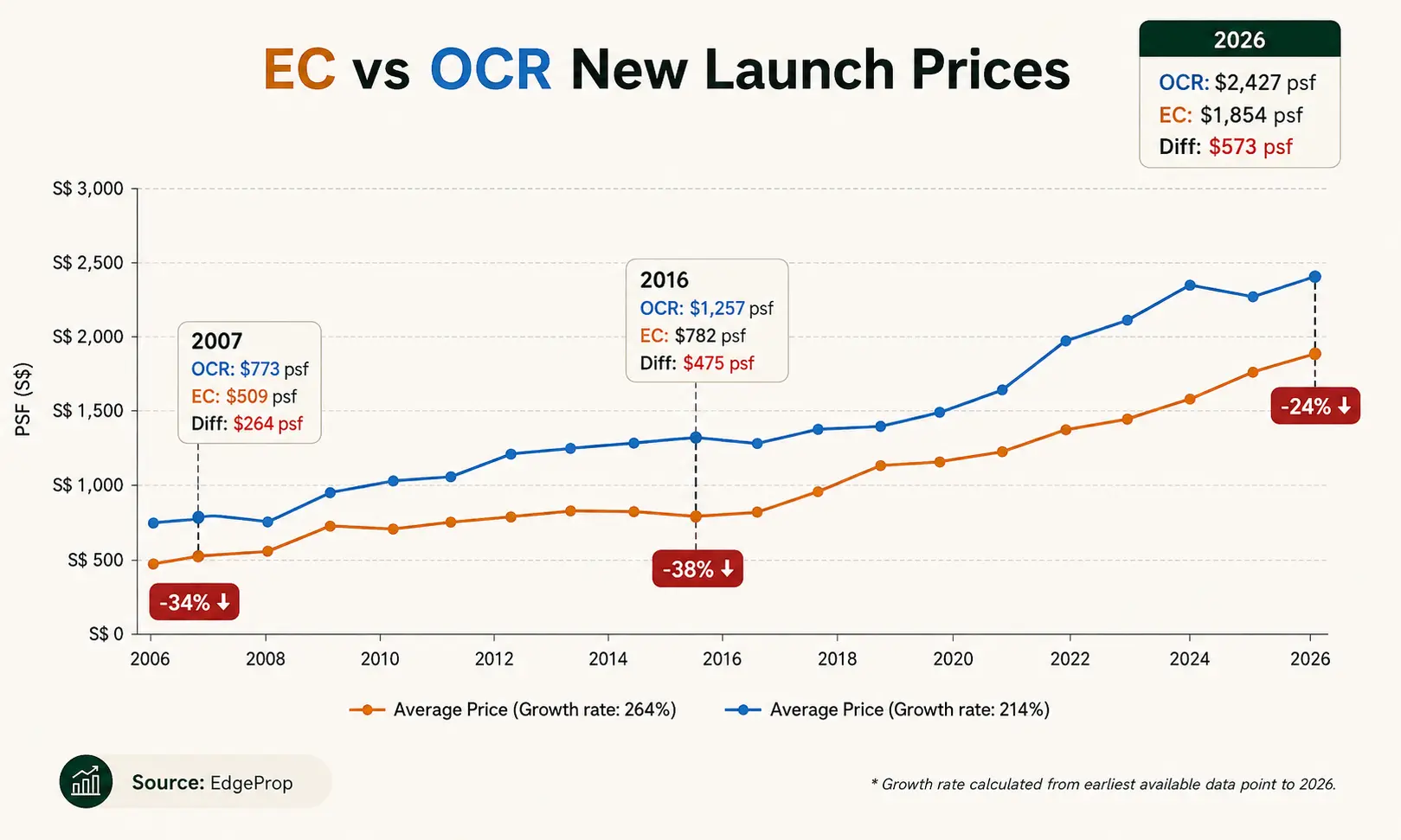
On the way in, ECs are cheaper. In 2007, a new EC averaged $509 psf against $773 psf for a new suburban launch. That is a gap of $264. By 2016 the two sat at $782 and $1,257. In 2026 they are $1,854 and $2,427, a gap of $573 psf. That is the widest gap in dollars on this series. In percentage terms it is narrower, at about 24 per cent, against 34 per cent in 2007.
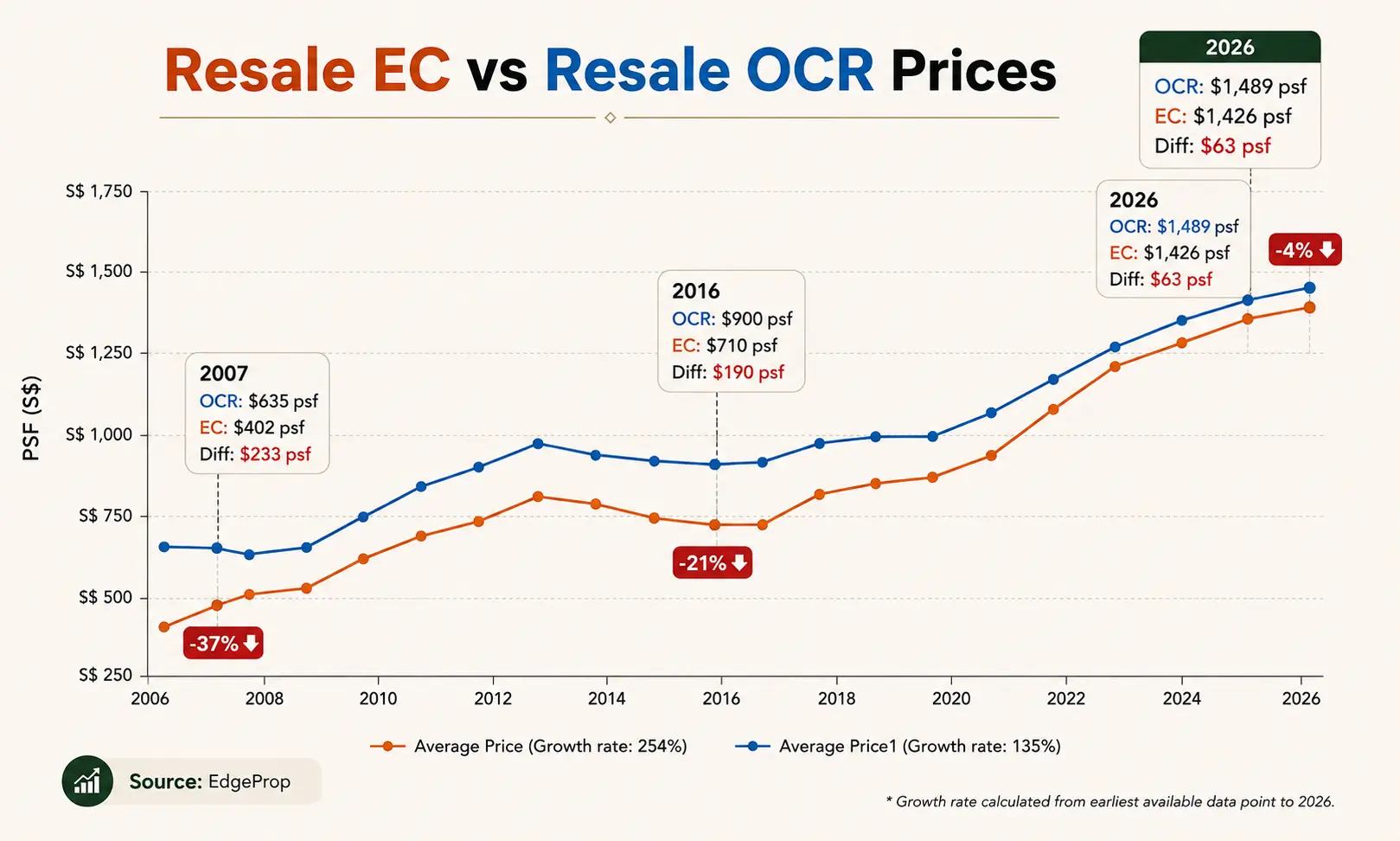
On the way out, the discount largely disappears. Resale ECs averaged $402 psf in 2007, against $635 psf for resale suburban condominiums. That is a 37 per cent gap. By 2016 it was $710 against $900. In 2026 it is $1,426 against $1,489, a difference of just $63 psf, or roughly 4 per cent.
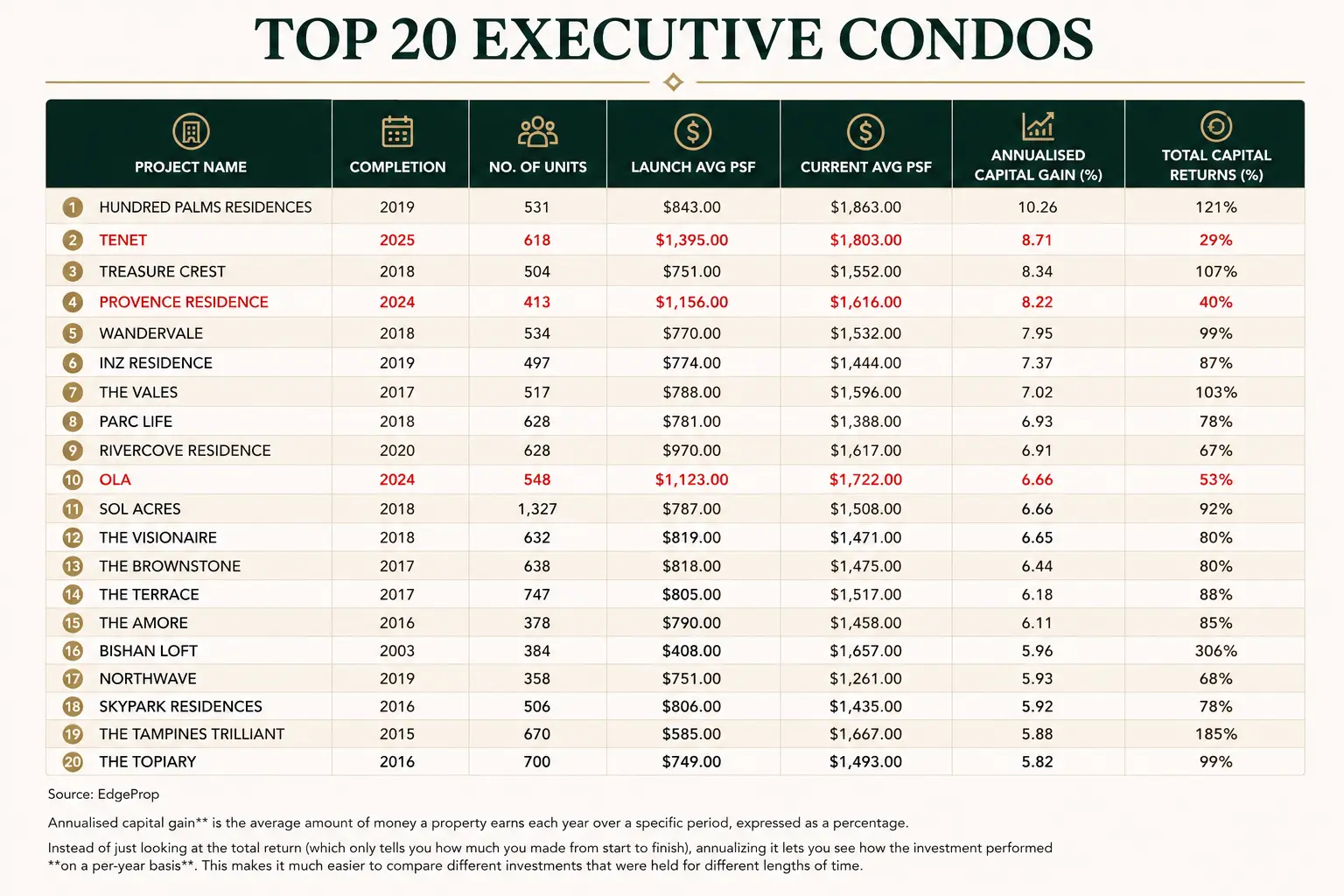
Enter at a discount, exit at close to parity. That gap between the two is the entire EC proposition. It explains the third chart in the seminar deck, a top-20 table where annual gains run from 5.82 per cent at The Topiary to 10.26 per cent at Hundred Palms Residences, with total returns of 121 per cent at the top. Notice that those returns are remarkably flat across the north, west and east. That is the tell. The return came from how the scheme is built, not from picking the right estate.
What does each of the measures actually do?
| Measure | Tender closed before 8 May 2026 | Tender closing on/after 8 May 2026 | What it bites |
|---|---|---|---|
| Minimum occupation period | 5 years, then open-market resale to SC/SPR | 10 years | The exit clock and the second-property window |
| Full privatisation | Year 10, sale to any buyer including foreigners | Year 15 | The buyer pool at final exit |
| Payment scheme | Deferred or normal progressive | Normal progressive only | Cash flow during construction |
| Launch-day quota | 70% first-timers / 30% second-timers | 90% / 10% | Ballot odds on booking day |
| Second-timer priority wait | 1 month | 2 years | Whether second-timers can plan around a launch at all |
Take the ten-year rule first. During that window, an owner may rent out rooms but not the whole unit. They may not sell. And they may not buy a second property. Those permissions now unlock at year ten instead of year five. Sale to foreign buyers moves to year fifteen instead of year ten. For a household running a fifteen-year plan to move up the ladder, that is not a delay. It is a different plan.
The deferred payment change is the sharpest of the three
It is also the least discussed. Under the deferred scheme, a buyer paid 5 per cent on booking, then 15 per cent on signing the sale agreement eight or nine weeks later. Then nothing at all across three to four years of construction. After that, 65 per cent fell due at completion and 15 per cent at the final certificate. Developers typically charged about 3 per cent more for the privilege. That works out to roughly one per cent a year of construction, which most buyers considered fair.
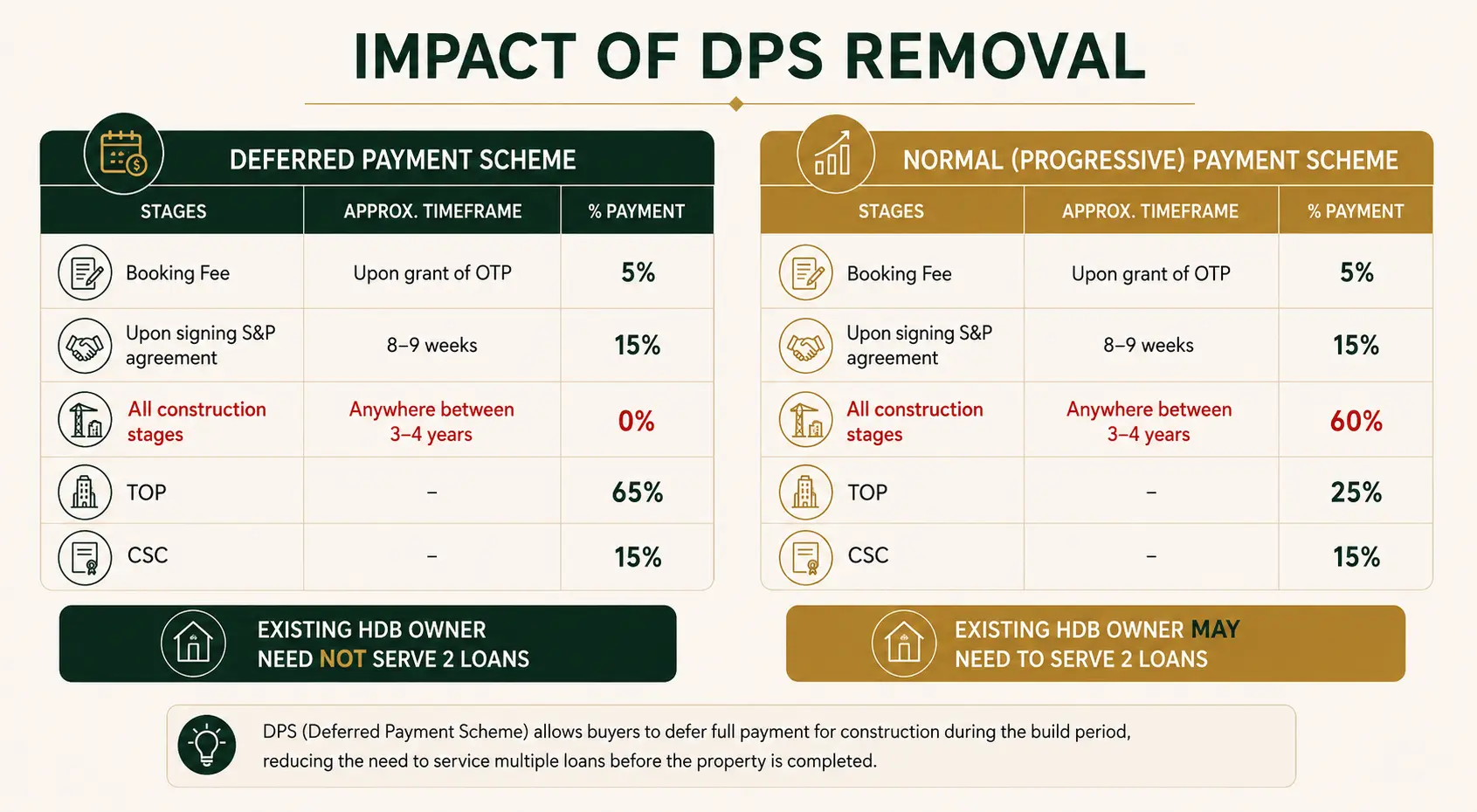
Under the normal payment scheme, 60 per cent falls due across those same construction stages, and only 25 per cent at completion. For a household still paying off an HDB loan, the deferred scheme was the difference between one mortgage and two. That is why it was used so heavily. At recent EC launches, close to 90 per cent of buyers took it, first-timers included. Remove it, and a second-timer must either service two loans through construction or sell the flat first. Selling first is exactly the behaviour the measure is designed to produce, and our guide to selling an HDB and buying a new launch walks through it step by step. Whether the sums work at all is a borrowing-limit question before it is a preference. The affordability calculator is the faster way to find out.
Which EC sites are affected, and which are not?
Only two. In the first half of the 2026 state land programme, just two EC plots fall under the new rules. Canberra Drive in Sembawang, at roughly 185 units, launched in May 2026. And Sembawang Drive, at roughly 450 units, launched in June 2026. Everything else in the visible EC pipeline was tendered earlier and keeps the old rules.
| Site | Area | Units | Land cost (psf ppr) | Land award | Preview window |
|---|---|---|---|---|---|
| Senja Close (Solano Grand) | Bukit Panjang | 295 | $771 | Aug 2025 | Q1 2027 |
| Woodlands Drive 17 (1H2025) — Wynwood Grand | Woodlands | 420 | $782 | Aug 2025 | Q4 2026 |
| Sembawang Road (EC) | Sembawang | 265 | $692 | Sep 2025 | Q1 2027 |
| Woodlands Drive 17 (2H 2025) | Woodlands | 560 | $794 | Jan 2026 | Q2 2027 |
| Miltonia Close (EC) | Yishun | 430 | $732 | Apr 2026 | Q3 2027 |
Two things stand out in the column of land rates. First, the five sites were awarded in a band of $692 to $794 psf ppr. That is a spread of barely a hundred dollars, across eight months and three towns. It tells you EC land was being bid to a formula rather than to a location. Second, the whole set is northern: Bukit Panjang, Woodlands, Sembawang, Yishun. A second-timer hunting old-rules EC stock in the east or the centre will not find any in the tender pipeline.
Wynwood Grand is the only one of the five with a preview window in the fourth quarter of 2026. That makes it the first real test of what old-rules EC stock is worth. CDL's project site keeps a running launch-watch log for Wynwood Grand, and we keep our own read in the Wynwood Grand deep dive. How each of these land rates sits against every other awarded plot is in the GLS pipeline tracker, and the wider tender context is in our 1H 2026 GLS review.
What does Coastal Cabana show about old-rules pricing?
It is the clearest live example of the old framework at work. Coastal Cabana sits in District 17, Pasir Ris. HDB awarded the land on 16 August 2024 at $729 psf ppr. Qingjian Realty, Forsea Holdings and ZACD Group are building 748 units, due for completion in 2029. At our last data refresh, roughly 83 per cent was sold at an average of about $1,790 psf. Three-bedroom units averaged $1,801, four-bedroom $1,789 and five-bedroom $1,782, across sizes from 872 to 1,421 sqft. Pasir Ris MRT sits just under a kilometre away. It is an interchange for the East-West, Cross Island and future Punggol lines.
Run those two numbers together and Coastal Cabana launched at 2.46 times its land cost. Our land cost tracker puts the median across 53 launched projects at 2.12 times. So the EC priced above the market-wide median multiple. Yet it still sold roughly $64 psf below the 2026 EC market average of $1,854, and about $637 psf below the suburban new-launch average. The method behind that multiple is in our pricing methodology.
Here is the reading we take from that. The discount buyers respond to is a discount against private new launches. It is not a discount against what the land cost. Developers have been converting the eligibility fence into their own margin, rather than passing it through. And Coastal Cabana's 79.8 per cent HDB-upgrader share says who was paying.
What is the case against the "last chance" framing?
Four reasons to be careful with the last-chance talk already circulating around old-rules stock.
Those top-20 returns were earned under conditions that no longer exist. Hundred Palms bought land in a different price cycle and launched at $843 psf. A buyer paying $1,790 psf today is not running the same trade. Annual gains of 6 to 10 per cent came from an entry discount that has narrowed and an exit gap that is now $63 psf.
The resale gap is the thinnest on record. Four per cent between resale ECs and resale suburban condos is close to the point where the convergence is finished. If the gap has already closed, later buyers inherit whatever the suburban market does, and nothing more.
Scarcity stories get priced in fast. The displaced second-timer demand is real, and sellers know about it too. A premium paid today for a five-year minimum stay has to be earned back at exit. And by 2031 the buyers you sell to will have new-framework alternatives.
Cheaper land under the new rules could reset the segment. A two-year lockout for second-timers, a 90 per cent first-timer allocation and a $16,000 income ceiling all give developers reason to bid more cautiously for EC land. If they do, new-framework ECs may launch at lower prices per square foot than old-rules ones. That is good for the buyers who get them. It is awkward for the resale comparisons of the group buying now.
What do we expect, and what would prove us wrong?
- The first visible effect appears in tender prices, not launch prices. EC plots closing after 8 May 2026 should draw more cautious bids than the $692 to $794 psf ppr band the old-rules set attracted. If new EC land clears above $800 psf ppr, developers do not believe the demand hit is real, and we are wrong.
- Second-timer take-up concentrates in the remaining old-rules launches through 2027. That is the observable version of the scarcity story. If old-rules ECs launch with the same first-timer-heavy mix as before, the displaced-demand argument fails.
- Smaller units come before lower prices. With a $16,000 income ceiling, developers pricing to first-timers are more likely to shrink the homes than to cut the price per square foot.
- No measurable effect on 2026 or 2027 completions. Nothing tendered under the new rules is finished before roughly 2031. So anything moving in EC prices this year comes from the launch pipeline, not from this change.
For the wider supply picture this sits inside, our analysis of the removal of the 15-month wait-out period covers the flow of upgraders. The upcoming launches list shows what is actually coming to market. And the price trends dashboard is where any further convergence between EC and suburban resale would show first. If you are new to buying off-plan, start with the guide to buying a new launch condo. The rest of the tracked pipeline sits under new launches.
The short version — read this first
Seven things to take away.
What we found
- Three rules changedLive there 10 years not 5. Full private status at 15 years not 10. And no more deferred payments
- Plus a quota change90% of launch-day units go to first-timers, up from 70%. Second-timers wait two years, not one month
- What triggers itThe land tender closing date. Projects on land already bought keep every old rule
- Why it happenedNew EC prices rose 57% from 2021, and second-timers had grown to about 70% of buyers
- The whole EC propositionEnter cheap, exit at near parity. In 2026 the entry discount is 24%, the exit gap just 4%
- The catch on "last chance" stockThat exit gap is the thinnest on record. If it has already closed, later buyers inherit nothing extra
- Where the effect shows firstIn land tender prices, not launch prices. Watch whether new EC land clears above $800 psf ppr
So what should you do with this?
- If you are a first-timer, your odds just improved a lot. Nine in ten launch-day units are now held for you.
- If you are a second-timer eyeing old-rules stock, check the tender date of the specific project with HDB before you plan around it.
- Do not pay a large premium for a five-year minimum stay. You have to earn that premium back at exit, against buyers who will have new-framework choices by 2031.
Frequently asked questions
What changed for executive condominiums on 8 May 2026?
Four things, for EC land whose tender closes on or after 8 May 2026. You must live in the home for ten years instead of five. It becomes fully private at fifteen years instead of ten. The deferred payment scheme is withdrawn, leaving the normal payment scheme as the only option. And 90 per cent of launch-day units go to first-timers, up from 70 per cent, with second-timers waiting two years instead of one month for the rest.
Does the 10-year MOP apply to ECs already launched or already sold?
No. The trigger is the tender closing date of the land, not the launch date and not your purchase date. EC sites whose tenders closed before 8 May 2026 keep the five-year minimum stay, privatisation at ten years, and access to deferred payments. That holds even if the project launches in 2027. ERA puts the unaffected pool at roughly 2,000 existing or upcoming units. Confirm the status of any specific project with HDB before committing.
Why did the government change the EC framework?
The stated reasons are stability, priority and prudence. Median new EC prices rose 57 per cent between 2021 and the first quarter of 2026. Second-timer households had grown to around 70 per cent of EC buyers, up from 20 to 30 per cent four or five years earlier, crowding out the first-timers the scheme was built for. And removing deferred payments pushes buyers onto normal payments, which starts the mortgage earlier and tests affordability sooner.
What was the deferred payment scheme and why does its removal matter?
Under it, an EC buyer paid 5 per cent on booking and 15 per cent on signing the sale agreement. Then nothing at all through three to four years of construction. After that, 65 per cent fell due at completion and 15 per cent at the final certificate. It typically carried a price premium of about 3 per cent. Under the normal scheme, 60 per cent falls due across the construction stages instead. For a household still paying an HDB loan, that is the difference between one housing loan and two.
How much cheaper is a new EC than a new private condominium?
In 2026 the average new EC sold at $1,854 psf, against $2,427 psf for new suburban launches. That is a gap of $573 psf, or about 24 per cent, on EdgeProp data presented by ERA. The gap has widened in dollars since 2007, when it was $264 psf. In percentage terms it has narrowed, from 34 per cent.
Do executive condominiums still sell at a discount after MOP?
Barely. Resale ECs averaged $1,426 psf in 2026, against $1,489 psf for resale suburban condominiums. That is a difference of $63 psf, or roughly 4 per cent. In 2007 the gap was $233 psf, or 37 per cent. Entering at a discount and exiting at near parity is the mechanism behind the EC scheme's historical returns. It is also the part most exposed if new-framework pricing resets the segment.
Is Coastal Cabana affected by the new EC rules?
No. Coastal Cabana sits on land awarded by HDB on 16 August 2024, well before the cut-off. So it keeps the five-year minimum stay, privatisation at ten years, and the deferred payment option. We track it at 748 units, roughly 83 per cent sold, at an average of about $1,790 psf, against a land cost of $729 psf per plot ratio.
Will EC prices fall under the new framework?
The likely mechanism is developer bidding, not a direct price control. With a ten-year hold, no deferred payment option and only 10 per cent of launch-day units open to second-timers, developers have reason to bid for land more cautiously. They also have reason to price nearer what first-timers can afford, which the $16,000 income ceiling caps. We expect tender prices for new-framework sites to be the first place any effect appears. Smaller units in the launch price list would be the second.
Sources & methodology
The policy facts on this page — the 8 May 2026 effective date keyed to EC land tender closing, the move from a five-year to a ten-year minimum occupation period, privatisation at year fifteen, the withdrawal of the deferred payment scheme, the 90/10 launch-day quota and the two-year second-timer priority period — are as announced by the Ministry of National Development and set out in the ERA Singapore consumer seminar deck of 8 July 2026, presented by James Poh, Group Division Director, ERA Realty Network. The price series (EC versus OCR new launch and resale, 2007 to 2026), the top-20 EC capital gains table, the payment schedule comparison, the 57 per cent median new EC price growth from 2021 to 1Q 2026, the second-timer share of about 70 per cent, the roughly 2,000 unaffected units and the GLS site tables are from that same deck, sourced to EdgeProp and to HDB, compiled by ERA Research and Market Intelligence. Figures described there as averages are market averages, not project-level data.
Project-level figures for Coastal Cabana and the five old-framework EC sites — land rates in dollars per square foot per plot ratio, unit counts, award dates, sold percentages, average transacted psf and bedroom-level psf — are from PropertyInsider.sg's own tracked dataset of 107 projects, last refreshed for this page on 3 August 2026. The land-to-launch multiple of 2.46× for Coastal Cabana is our own calculation, dividing its average transacted price of about $1,790 psf by its awarded land rate of $729 psf ppr; the 2.12× benchmark is the median of the same calculation across the 53 launched projects in our land cost tracker. Preview windows in the site table are taken from our own tracker rather than from the seminar deck, which carried indicative launch quarters that differ in three cases.
Disclaimer. This article is independent research published for general information and education. It is not financial, investment, legal, tax or property advice, and it does not consider your circumstances. PropertyInsider.sg does not adjudicate executive condominium eligibility, income-ceiling assessment, grant entitlement or minimum occupation period status — those sit with HDB, and buyers should verify at HDB.gov.sg and take their own professional advice before committing. The expectations set out above are the publication's own view, deliberately falsifiable, and may prove wrong. Figures are compiled in good faith from sources believed reliable as at 3 August 2026 but are not guaranteed. wynwoodgrands.sg is cited above as a project's own website; how the publisher's related commercial interests are managed is explained in our editorial policy, and how we handle your data in our privacy policy.
Update history
- Article published, covering the three measures in the 8 May 2026 EC framework revision, the 2007–2026 EC and OCR price series, the payment-scheme comparison, the affected and unaffected GLS site tables, and the Coastal Cabana land-to-launch calculation. Next scheduled update: on the tender result for the first EC parcel closing under the new framework, and on the launch price list of the next old-framework EC.