
Five slow forces set home prices here. Interest rates. People and pay. Land costs. Housing rules. The health of the economy. Headlines move mood, and mood turns in a week. These five turn over years. Tell the two apart and most of the noise answers itself.
Every week I meet buyers frozen by the news. Wars, oil prices, market swings. The question is always the same. Should I buy now, or wait until things settle? ERA's March 2026 Monthly Direction briefing gave the sharpest answer I have heard, and it was not a sales pitch. It was a distinction. Headlines move sentiment. Five structural forces move prices.
Six terms used in this article
- Property Price Index (PPI)URA's quarterly measure of how much private home prices have moved overall
- SORASingapore Overnight Rate Average. The benchmark rate most floating home loans are priced off
- GLSGovernment Land Sales. The programme through which the state sells land to developers by tender
- psf pprWhat a developer paid for land, per square foot of floor space it is allowed to build
- MOPMinimum Occupation Period. The number of years you must live in a subsidised flat before you may sell it
- ABSDAdditional Buyer's Stamp Duty. An extra tax on second and later homes, and on purchases by foreigners and companies
What has actually caused Singapore property prices to fall?
Three things, and only three. In thirty years the Property Price Index has had exactly three big falls, each with its own cause. The Asian Financial Crisis of 1997 to 1998 had three things at once. Banks stopped lending. Firms went under. And too many new homes had been built. The index fell roughly 40% to 45% from its peak, and the slump lasted years. The 2008 Global Financial Crisis froze credit worldwide but found no local oversupply. Prices fell a sharper but shorter 20% to 25% and had recovered by 2010. The 2013 to 2017 decline was not a crisis at all. It was policy on purpose: the Additional Buyer's Stamp Duty, the Total Debt Servicing Ratio and tighter loan limits. That produced an orderly fall of about 10% to 15% over four years, with no panic selling.
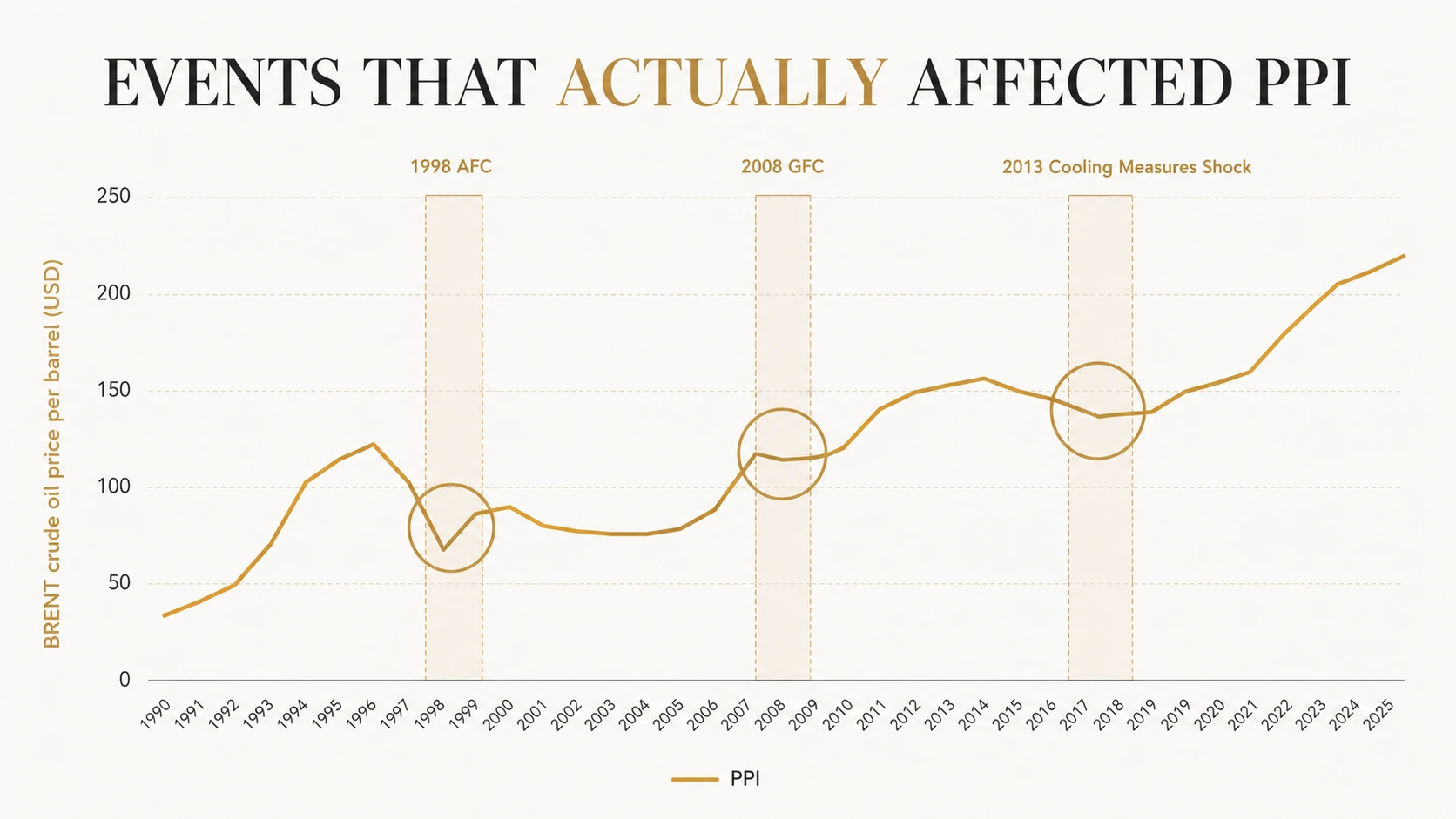
So the checklist is short. Prices fall when there is a credit or banking crisis, a severe recession with job losses, or heavy policy tightening. Run 2026 against it. Banks are not under stress, and lending has stayed careful under the debt-servicing rules. There is no recession, as force five shows. Policy is the live variable, and I return to it honestly below, because that is where this framework has been tested hardest since March. What we have today is uncertainty about mood, not any of the three conditions that have actually caused a crash. With that settled, here are the five forces and my read on each.
Force 1 — How much have Singapore mortgage rates fallen?
A long way. The three-month compounded SORA, the benchmark behind most floating home loans here, sat at about 1.12% at the time of the March 2026 briefing. Its peak in the 2023 tightening cycle was roughly 3.7%. That is not a tweak. On a $1.5 million loan over 30 years, the gap between those two rates is around $2,000 a month.
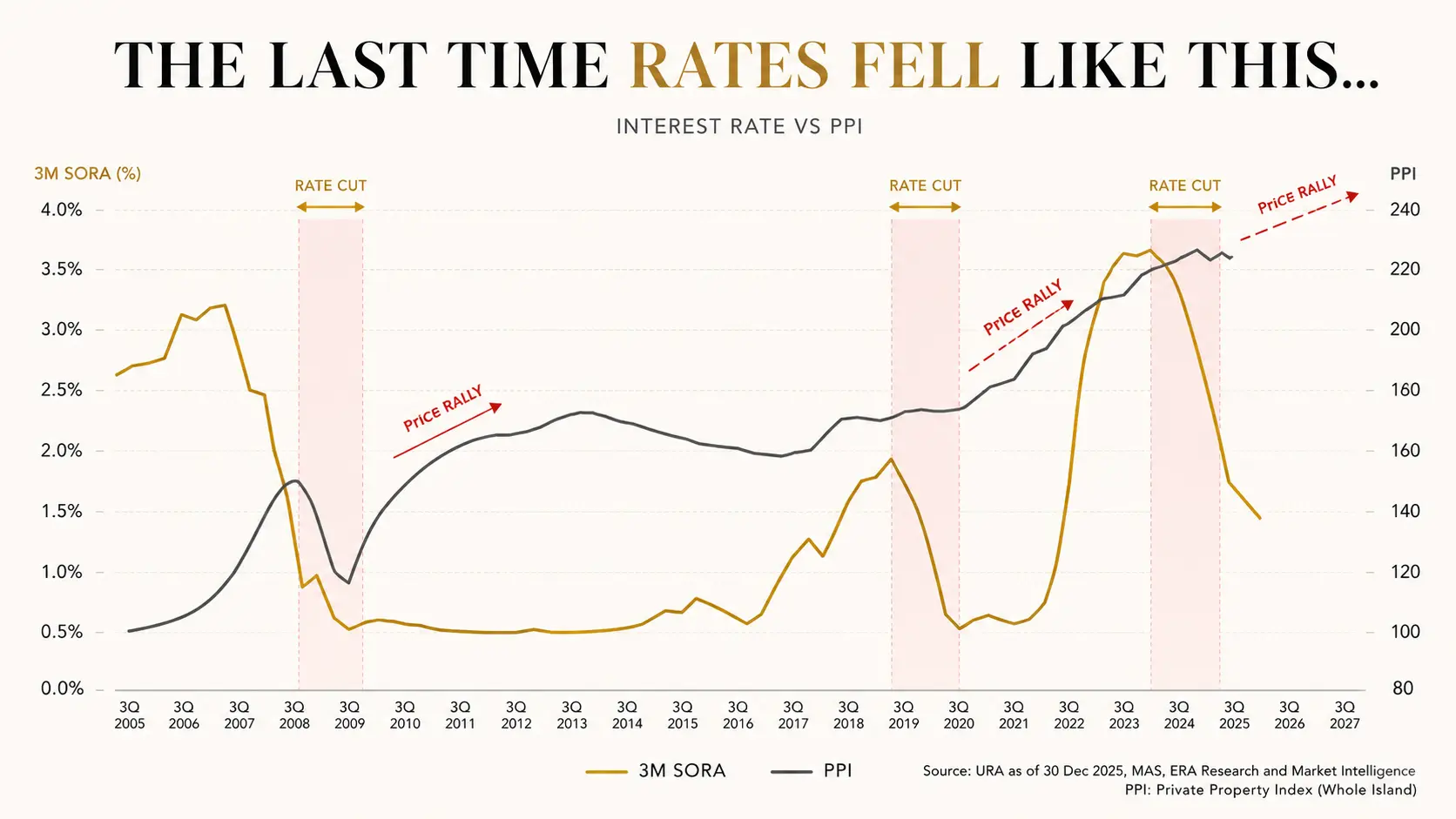
The briefing argues this film has run before. After rates fell sharply in 2009 and again in 2019, deal volumes recovered first and price gains followed. The proposed order is: rates fall, transactions recover, prices speed up. That puts 2026 at step two, heading into step three. It is why ERA's chief executive Marcus Chu called it a possible turning-point year, meaning the window where borrowing has got cheaper but prices have not yet risen to swallow the benefit. Four months on, the transaction step is behaving as scripted. April alone saw over 1,500 new private homes sold. Even June, a month with no new launches at all, cleared 156 unsold units. My caveat is firmer than the deck's. Rates that fell this fast can climb back. If you borrow at 1.12%, work out the monthly cost at 3% first.
Force 2 — Are there more buyers, and can they afford more?
Yes to both. Singapore plans for a population near 6.5 million by 2030. Fewer babies are being born, so new arrivals make up the gap. The housing sum is dull but relentless. More people form more households, and more households need more homes. Force three shows the land supply that must meet them is anything but flexible.
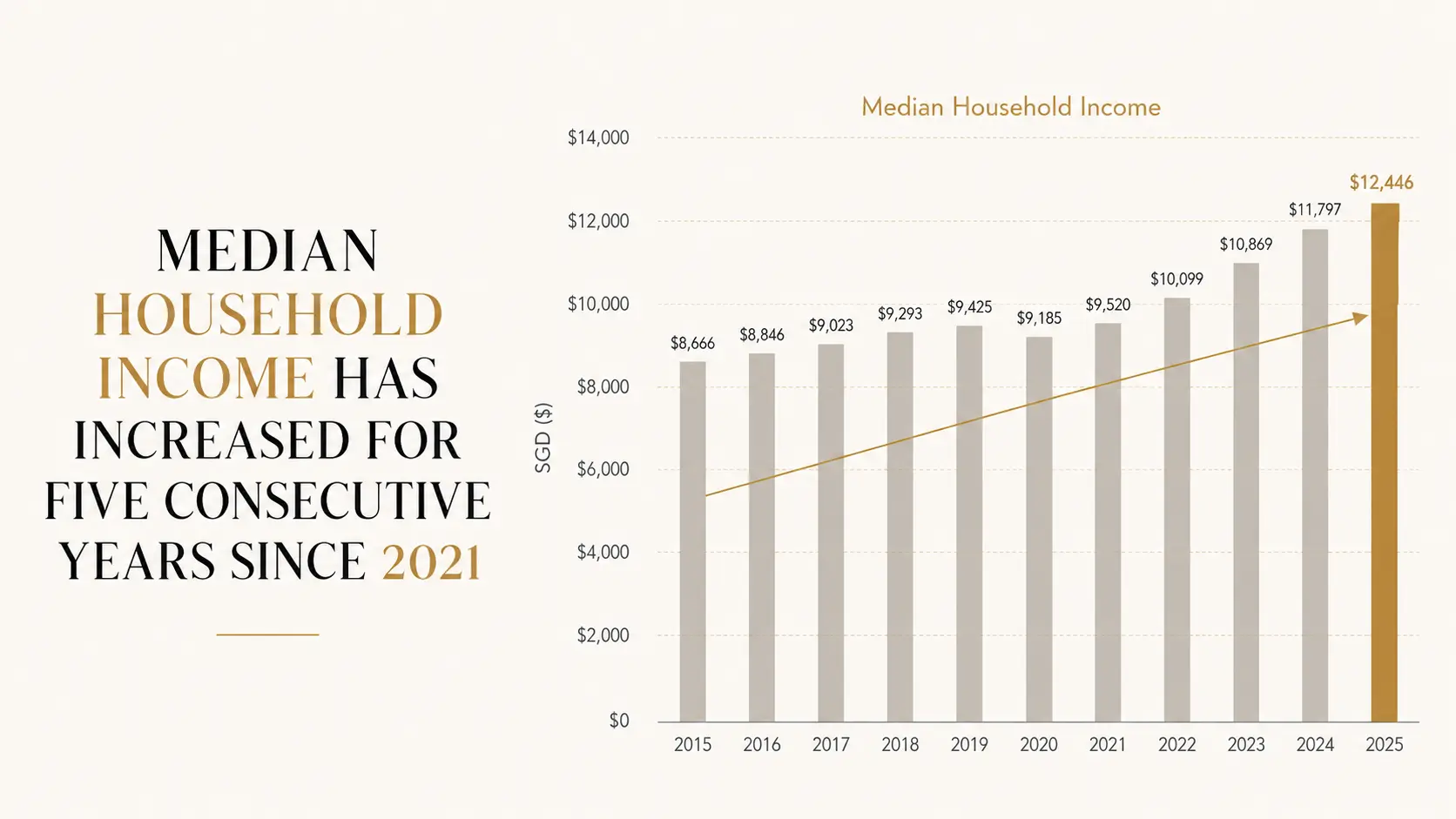
Demand is not only bigger. It is better funded. Median monthly household income has risen five years in a row, from $9,520 in 2021 to $12,446, according to the SingStat figures in the briefing. Household wealth has climbed with it. In my own work this shows up as staying power. Buyers who do not need to sell in a downturn do not sell in a downturn. In 1998, owners had to sell. Today, very few do. That is why the rate spike of 2022 and 2023 produced a slowdown rather than a fall.
Force 3 — Why do government land prices keep rising?
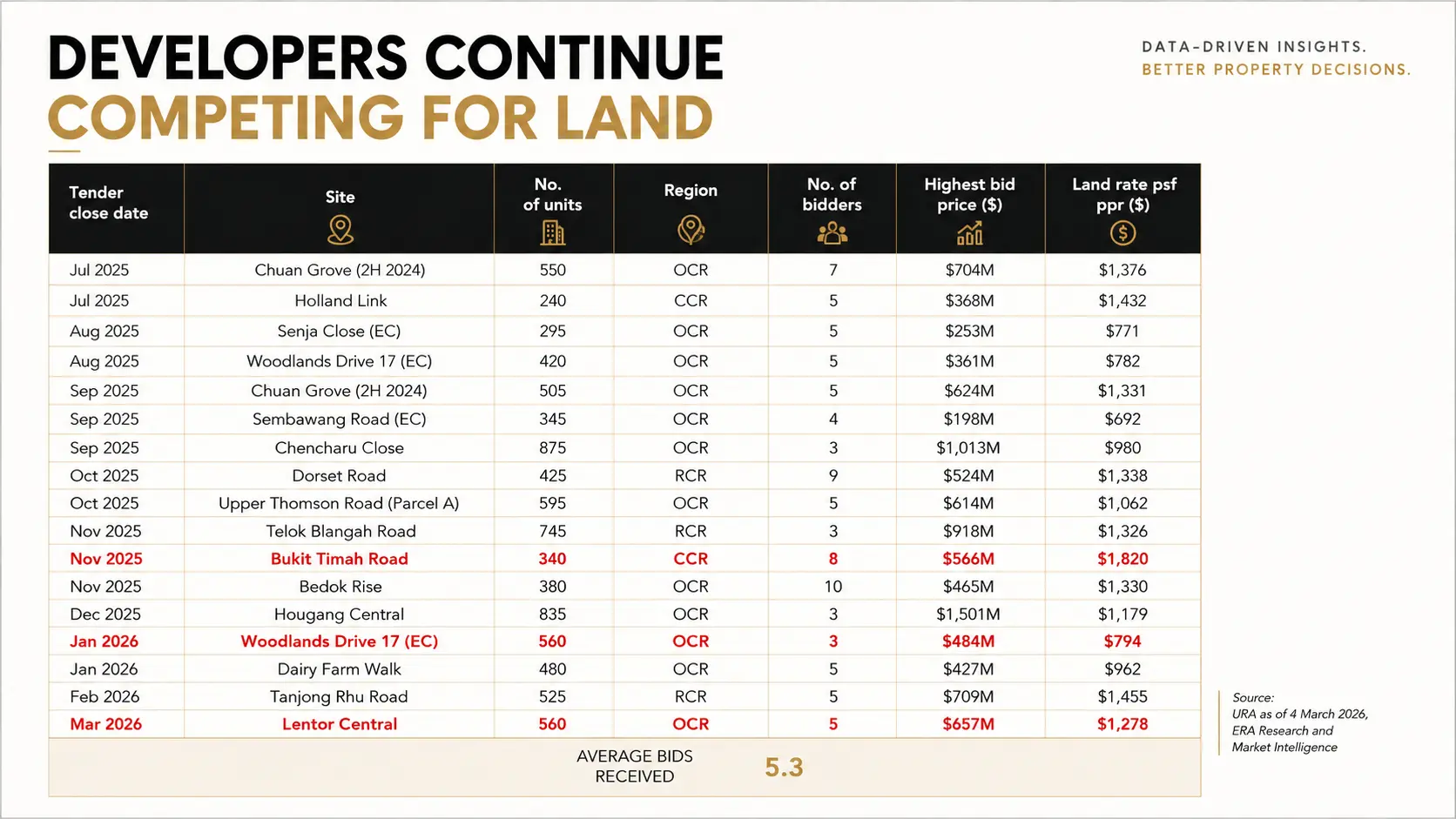
Because too many developers chase too few plots. From July 2025 to March 2026, government land tenders drew an average of 5.3 bids per site. Think about what that means at each award. Roughly four developers walk away with nothing. They still need land, so they come back to the next tender and bid harder. Repeat that for nine months and you get a ratchet. That is exactly what the results show.
Take three examples. In the CCR (Core Central Region), the Bukit Timah Road site at Newton was awarded in November 2025 at $1,820 psf ppr. That is a record for the region, apart from the standing high of $2,377 set at Cuscaden Road in 2018, and well clear of Orchard Boulevard's $1,617 in 2024. In EC land, Woodlands Drive 17 set a record $794 psf ppr in January 2026, just past the $782 paid for the plot next door. And in Lentor, now eight state plots deep with six projects launched, the March 2026 Lentor Central award came in at $1,278 psf ppr, above the area's previous high of $1,204. Days earlier, Bayshore Drive drew eight bids and a winning $1,323 psf ppr. The pattern has continued since. Our 1H 2026 GLS review and pipeline tracker log every award with a rough launch price. The ten-year land cost dataset shows how land prices have fed launch prices. Our pricing methodology explains how we do that sum.
One line from the briefing has stayed with me: today's high becomes tomorrow's low. Land bought at these rates, plus rising building costs and redevelopment charges, becomes the cost base of launches in 2027 and 2028. That is why the land market works as an early price signal for homes, and why I publish my own site-by-site analyses for buyers deciding between today's launches and tomorrow's dearer ones. It is also the strongest structural argument in the deck, because a mood can change but an awarded tender cannot be un-bid.
Force 4 — Do the Prime and Plus flat rules push buyers toward private property?
At the margin, they may. Singapore launches more than 100,000 BTO flats a decade, and public housing remains the base of the system. What is changing is the small print on the most desirable flats. Prime and Plus flats carry a 10-year minimum stay instead of five, tighter resale rules, and a $14,000 household income ceiling on who may buy them. They also carry a subsidy clawback when you sell, meaning a share of the resale price returns to HDB. That share has been climbing: 6% when the framework began in 2023, 14% at Berlayar Residences on Telok Blangah Road, and analysts expect around 20% (est.) at the 60-storey Pearl's Hill project. That last figure is an analyst estimate quoted in the briefing, not confirmed by HDB.
The briefing put this as a question, and I will keep it that way. Say the most central flats come with a ten-year lock-in, tighter resale rules and a bigger clawback. Do some households then do the sums and look at private homes sooner than their parents did? My client conversations say yes, at the edges. It is most common among dual-income couples near the $14,000 ceiling, where the clawback on a Prime flat can rival the extra cost of a modest private unit. This is a gradual shift, not a stampede. It shows up in the step-by-step upgrade planning I do with clients, and the mechanics are covered separately in PropertyInsider's buyer guides and calculators.
Force 5 — Is Singapore's economy strong enough to hold prices up?
So far, yes. The economy grew 4.8% in 2025. It beat the official forecast quarter after quarter, in a year of global worry. The 2026 official forecast of 1% to 3% is a cautious one, as usual. The briefing's view, which I share, is that an upside surprise is plausible again, because during global stress money tends to move toward stable places rather than away from them. Money from abroad has kept coming in through all the worry. Big firms are voting the same way buyers do at a showflat.
This force frames the other four. It is why cheaper borrowing meets buyers who have jobs and rising pay, why developers keep underwriting record land bids, and why the government can fine-tune policy instead of fighting a fire. Every past crash needed a broken economy to drive it. Nothing like that is running now.
Where could this framework be wrong?
An opinion piece that only agrees with its source is not worth your time. So here is my stress test, starting with the force that has already moved against the deck. In May 2026, two months after the briefing, the government rebuilt the EC rules. On land sold from 8 May, buyers must stay 10 years. Deferred payments are gone. And 90% of units go to first-timers. That is force four working in reverse. Policy as a brake, not a nudge. It is a live reminder. Heavy tightening is the third crash condition, and it is always one announcement away. I unpacked those changes in The new shape of Singapore housing demand. The short version is that policy risk deserves a permanent seat in any view of this market, and reading force four in one direction only is this framework's soft spot. I picked the thread up again after ERA's July outlook in A record MOP wave meets a thin launch pipeline.
Three more caveats. First, rates. A SORA of 1.12% is a tailwind, but the same global volatility the briefing waves off as noise could tighten credit again. The 2019 rate decline, after all, was followed within a year by a pandemic nobody had modelled. Second, there is a limit to what buyers can pay. Pay has risen about 30% since 2021. New-launch prices have risen faster. Land costs cannot keep feeding launch prices once the monthly bill outruns the median pay cheque. Third, the pattern of "rates fall, then prices rally" rests on two past episodes. Two cases is a rhyme, not a law. None of this breaks the framework. All of it is the set of conditions under which I would revise it.
How should you use the five forces?
As a filter. When a headline lands, ask which of the five forces it actually changes. A trade dispute changes none of them. A land tender result changes force three. That change is real and it does not reverse. A new cooling rule changes force four, sometimes in a day. Most weeks the honest answer is "none". That is the clarity the title promises. Your question shifts from "is this the perfect moment?" to "am I set up for the next decade?" If you want to work out where your own situation sits, I wrote a life-stage companion to this piece in Buy, wait or upgrade, and I keep a running 2026 macro outlook tracking these same five variables. The noise will keep coming. The forces move slowly. Watch the forces.
| Force | What it measures | Where it stood in 2026 | Direction |
|---|---|---|---|
| 1. Interest rates | Cost of borrowing, via the 3-month SORA | 1.12%, down from a 3.7% peak | Supportive |
| 2. People and pay | Households formed, and what they earn | $12,446 median monthly income, up 5 years running | Supportive |
| 3. Land costs | What developers pay at state tenders | 5.3 bids per site; records in 3 segments | Pushes prices up |
| 4. Housing policy | Rules on who may buy what, and when | Prime/Plus clawback up to 14%; EC rules tightened 8 May | Cuts both ways |
| 5. The economy | Growth, jobs and inbound investment | GDP +4.8% in 2025 | Supportive |
The short version — read this first
Seven things to carry away from the five forces.
What the framework says
- Prices fall for three reasonsA credit crisis, a bad recession, or heavy policy tightening. None of the first two is present in 2026
- Force 1: borrowing got cheaperThe SORA benchmark fell from about 3.7% to about 1.12%. On a $1.5 million loan that is roughly $2,000 a month
- Force 2: buyers are better fundedMedian household income rose five years running, from $9,520 to $12,446 a month
- Force 3: land keeps getting dearerGLS tenders drew an average of 5.3 bids. Records were set in the CCR, in EC land and in Lentor
- Force 4: policy cuts both waysPrime and Plus flat rules nudge some buyers private. The May 2026 EC changes push in the opposite direction
- Force 5: the economy held upGDP grew 4.8% in 2025, and money still flows in during global stress
- The honest weak spotPolicy is one announcement away from changing, and the "rates fall then prices rise" pattern rests on only two past episodes
So what should you do with this?
- Next time a headline worries you, ask which of the five forces it actually changes. Most weeks the answer is none.
- If you are borrowing at today's low rates, check your repayment at 3% before you commit. Rates that fell this fast can climb back.
- Write down what would make you change your mind. If nothing would, you are not holding a view, you are holding a hope.
Frequently asked questions
What are the five structural forces shaping Singapore property in 2026?
They come from ERA's March 2026 briefing. One, interest rates: the three-month SORA fell from about 3.7% to about 1.12%. Two, people and pay: the population is heading toward 6.5 million by 2030, and median household income has risen five years running to $12,446. Three, land: state tenders drew an average of 5.3 bids, with records in three segments. Four, housing rules: Prime and Plus flats carry more restrictions and a bigger clawback. Five, the economy: it grew 4.8% in 2025.
Have Singapore interest rates actually come down in 2026?
Yes. The three-month compounded SORA benchmark, which sets most floating home loans here, fell from a peak near 3.7% in late 2023 to about 1.12% by March 2026. After rates fell in 2009 and again in 2019, sales picked up first. Prices came later. That is the basis for calling 2026 a possible turning-point year.
What has historically caused Singapore property prices to fall?
Three conditions have done it: a credit or banking crisis, a severe recession, or heavy policy tightening. The 1998 Asian Financial Crisis, which combined a credit collapse with oversupply, cut the index roughly 40% to 45%. The 2008 Global Financial Crisis produced a sharper but shorter fall of 20% to 25%. The cooling measures of 2013 to 2017 delivered a controlled decline of 10% to 15% with no panic selling.
Why do GLS land prices keep rising?
Because state-controlled supply is scarce and developers keep competing for it. Tenders averaged 5.3 bids from July 2025 to March 2026. That means about four developers leave every award with nothing and bid harder next time. The results show it: $1,820 psf ppr at Bukit Timah Road in November 2025, a record $794 psf ppr for EC land at Woodlands Drive 17 in January 2026, and $1,278 psf ppr at Lentor Central in March 2026.
How do the Prime and Plus BTO rules push demand toward private property?
Prime and Plus flats carry a 10-year minimum stay, tighter resale rules, a $14,000 income ceiling, and a clawback of part of the subsidy when you sell. That clawback has risen from 6% in 2023 to 14% at Berlayar Residences, with analysts estimating around 20% (est.) at Pearl's Hill. For households near the income ceiling, those conditions can make an earlier move to private property worth comparing.
Is 2026 a good time to buy property in Singapore?
That depends on your income stability, your savings buffer, whether you would pay Additional Buyer's Stamp Duty, and how long you plan to hold. Nothing here is financial advice. The framework claims something narrower. None of the three crash conditions is here. Borrowing is cheaper, with rates near 1.12%. And land costs are rising under future launches. The case against, covering policy risk, a rate rebound and affordability limits, is set out above.
Sources: ERA Singapore Monthly Direction briefing, "From Noise to Clarity: Five Forces Shaping Singapore Property in 2026", presented by CEO Marcus Chu, 19 March 2026 — drawing on URA Property Price Index and GLS tender data, HDB BTO and Prime/Plus policy parameters, MAS interest-rate data (3M compounded SORA), SingStat household income statistics, and ERA Research and Market Intelligence; figures reproduced with attribution. Post-briefing market data from URA and PropertyInsider.sg tracking as of 17 July 2026. Figures marked (est.) are analyst estimates, not officially confirmed. Historical PPI outcomes describe past cycles, not projected returns.
Page history: 17 Jul 2026 — first published. This page will be updated if any cited figure is materially revised by its source.